Japanese divided on Iraq troop deployment
( 2003-07-30 10:56) (Agencies)
When the bill passed to send Japanese troops to Iraq to help US-led reconstruction efforts, mayhem broke out in Japan's usually staid Parliament as lawmakers shoved, shouted and jumped on desks in outrage.
|
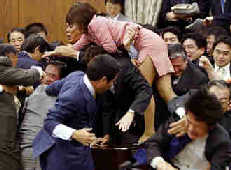
Opposition lawmaker Yuko Mori in a red and white suit joins a crowd of her fellow lawmakers swarming toward a chairman, unseen, to stop the passage of the Iraq bill forced by the ruling party at the upper house in Tokyo Friday, July 25, 2003. [AP]
|
The uproar underlined the challenge facing Prime Minister Junichiro Koizumi in winning over a public skeptical about Japanese soldiers heading to a war zone for the first time since World War II.
This is a nation that has shunned military actions for more than a half-century under a pacifist constitution written by US occupiers and there are deep worries about the mission.
Many fear casualties are likely in Iraq, and that prospect is especially irksome to those who see it as an American, and perhaps unjustified, war. Some worry about any step that might lead to a revival of Japanese militarism.
Supporters of the mission argue that Japan needs to take on more of the risks and burdens faced by other countries on the world stage. They also point to a need to stand by the United States, a key ally and important bulwark against such potential threats as North Korea.
Koizumi said Tuesday that Japan has a duty to help reconstruct Iraq. "Japan can't just focus on itself and ignore other countries... It has to play a role in the international community," he said at his first news conference since Parliament voted Saturday to authorize the Iraq mission.
But Koizumi also stressed that Japanese troops will not participate in combat missions and will take on reconstruction projects only in peaceful areas. He said Japan will send the contingent — reportedly 1,000 soldiers — only after a government team confirms it is safe to do so.
The legislation allows the government to send troops to overseas trouble spots only to offer medical assistance, repatriate refugees, reconstruct buildings and roads, and give administrative advice.
The idea is requiring big social and psychological adjustments for the Japanese, who are accustomed to seeing their soldiers help out at home after floods and earthquakes — not risk their lives.
A recent poll by the newspaper Asahi said 33 percent of Japanese supported the mission, while 55 percent opposed sending troops to Iraq, mainly because of the danger.
"Sending Japan's forces abroad is against out constitution," said Kimie Kakushima, a trading company employee in Tokyo who is horrified by the plan. "Some of them will probably get killed."
Small Japanese military contingents have taken part in several UN peacekeeping operations since 1992, most recently in East Timor. But only one serviceman has died on those missions, and that was from a heart attack while on a military vessel in the Indian Ocean.
"For more than 50 years, our soldiers have never been killed and never killed anyone. It's a military we can be proud of," said Keiko Higuchi, an analyst and scholar. "We can't accept our prime minister's decision, which is more about his desire to be on good terms with the US president than about national interest."
Yet Japan has come a long way from the early decades following its defeat in World War II, when liberal-leaning intellectuals, worried about a return to a militarist past of invasions and atrocities, persistently denied the nation had a military at all. Today, Japan has one of the best-equipped and financed militaries in the world.
Recent Japanese governments have been pushing to play a bigger military role internationally.
These days, Japanese must also think of the potential threat from neighbor North Korea, which is suspected of pursuing a nuclear weapons program. Most people feel they have no option but to count on the United States should the isolated communist state make good on its repeated threats to attack Japan.
Partnership with Washington is seen as critical in deterring possible nuclear attack because Japan has no nuclear weapons or missile defenses. Fears of a nuclear attack are extremely sensitive for Japan, which is the only nation to suffer nuclear bombings.
"Japan should, of course, send troops to Iraq to cooperate with its ally, the United States," said Koji Moriwaki, a 29-year-old bank worker. "Japan should do its part."
William Breer, head of the Japan program at the Center for Strategic and International Studies in Washington, sees Japan's decision as a boost for the US-Japan alliance.
"Japan is stepping up to take responsibility for global stability, and that's a move in a constructive direction," he said in a telephone interview.
|




