| .contact us |.about us | |
|


|
|
|
|
|||||
|
|
|
|
|||||
 |
||
|
|
|
|
|
|
|
||
|
|
|
|
|
| Advertisement | |||||||||||||||||||||||||||||||||||||||||||||||||||||||||||||||||||||
|
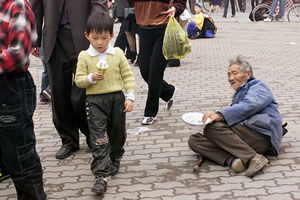
Living off pity ( 2003-12-19 08:49) (Shanghai Star) It seems that suddenly an unpredecedent number of beggars have appeared on the streets of Shanghai.
Boys with extremely thin legs wrapped over their shoulders move on their hands along Huaihai Lu; teenagers in school uniforms kneel in front of a sheet of paper telling of their misfortune, asking for money to take them back to school; and elderly or handicapped people extend their hands at bus stops or on subway trains. The beggars are literally up and down and all over the city. People have started to ask questions about their alleged misfortune and deformity after a period of initial sympathy. Can there be so many children who seem to be handicapped in the same way? Rumours have it that these children with skinny legs twisted up over their shoulders can actually walk on their own two feet but they pretend to be handicapped to gain people's pity. "They have loose ligaments. A child can do that after some exercise," according to some locals. But their skinny and deformed legs certainly don't look normal or healthy and they look extremely cold with their legs, sometimes even their backs, exposed to the winter chill. Organized business An investigation by Xinmin Weekly found that there was an "industry" behind begging. Organizing handicapped children to "work" as professional beggars in big cities has become a profitable business. In a village in East China's Anhui Province, "businessmen" hire handicapped children, agree to pay their parents a certain amount of money every month and then take them away. They believe the "profession" is not shameful and that they are relieving the parents of the burden of supporting a handicapped child. In today's China, when the State can't afford to run a generous social welfare system to help the handicapped, their argument may seem hard to rebut. "It is because of progress that we can see beggars in the city," said a local man in his 30s. It was only a few months ago that immigrant beggars and wanderers were being rounded up by the police to be sent back to their hometowns. Now the city's police force has to cope with the problem of organized begging without infringing the rights of beggars. 'Gai Bang' Although begging as an organized business may seem to be a novel phenomenon, organizations of beggars are nothing new in China. "Gai Bang" is a familiar word to Chinese readers of martial arts stories. In a book by the best-known contemporary martial art writer, Jin Yong, a "Gai Bang" is a large organization led by a martial arts guru. The group played an important role in fighting against minority ethnic groups' invasions during the late Song Dynasty (960-1279). The "Gai Bang" in the tale has a strict ranking system, marked by the number of bags a beggar carries. The more bags one carries, the higher the rank he has in the group. Not all the beggars live in rags and filth. There is a division in "Gai Bang" called the "clean-dressed". They are well-off people with property who join the organization willingly because they identify with the values of the group. They just wear a few patches on their clothing to signify their identity and self-chosen way of life. Like the Greek philosopher Diogenes, members of the "Gai Bang" look down upon society's pursuit of worldy pleasure. A well-known dish of Hangzhou cuisine was supposed to have been invented by beggars. The dish, "Beggars' Chicken", is made by wrapping the bird in clay and lotus leaves and then baking it in a fire pit. According to folk legends, beggars invented this dish because they didn't have a proper oven or pot to bake it in. Instead, they would dig a hole in the ground, put the wrapped chicken inside and then light a fire over it. By the time it is fully warmed by the fire, they remove the ashes to unearth the well-cooked chicken. The feathers come off when the clay is broken while the lotus leaves add a fresh fragrance to the meat. The story may not be true, but the dish is still served in restaurants today. Illiteracy fighter The martial arts guru is only a literary creation but there was a real hero beggar in Chinese history, Wu Xun (1838-96). Born into a poverty-stricken family in East China's Shandong Province, Wu couldn't afford to go to school. After begging and suffering from various hardships in life for years, Wu decided that his misfortune came from his illiteracy. He decided to build a school free of charge for poor children like himself. In order to raise funds for his dream school, he went about begging, singing, playing the fool and enduring humiliation for decades. Moved by his spirit, some local landlords supplied money for his school project. Wu's conduct was highly praised by the emperor, who awarded him a yellow
coat. It was believed that the yellow colour was to be reserved especially for
the imperial family, so it was a very high honour for the emperor to grant a
yellow outfit to an ordinary person. Wu, however, declined to wear
it.
|
|
 |
|||||||||||||||||||||||||||||||||||||||||||||||||||||||||||||||||||
| .contact us |.about us | |||||||||||||||||||||||||||||||||||||||||||||||||||||||||||||||||||||
|
|
|
|
|
|
|
|
| Copyright By chinadaily.com.cn. All rights reserved |