Sculptor's works rekindle links with cultural icons


 |
|
[Photo provided to China Daily] |
Chinese sculptor Li Xiangqun, 55, brings to life ancient Chinese cultural icons, such as Su Dongpo, the Song Dynasty (960-1279) writer and statesman. He does this to bring these distant figures closer to modern-day Chinese.
The Beijing-based artist's works produced earlier this year include four statues portraying "Four Masters of the Yuan Dynasty (1271-1368)". The collective term refers to Huang Gongwang, Wang Meng, Wu Zhen and Ni Zan, imperial painters who are revered to this day as exponents of the Chinese literati painting style.
He depicts the four figures differently, interpreting the lives of these ancient Chinese artists and scholars.
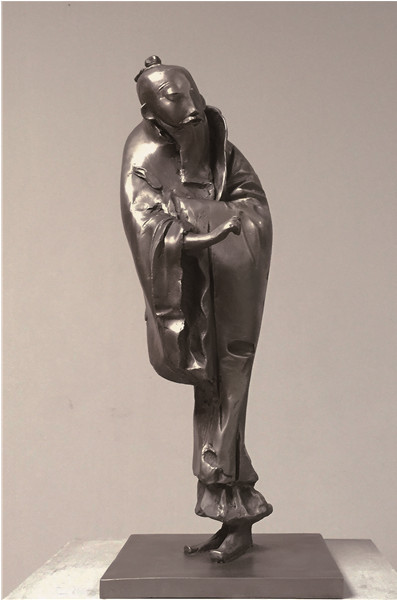
For instance, the statue of Huang (pictured left) shows him with rolled up sleeves reaching out his right hand as if he is about to paint, but he does not have a brush because Li says he wants to emphasize the manner of the icon, rather than the technique which distinguished Huang from his generation of artists.
The statue of Wang shows him relaxing in a chair to convey a Zen feeling and a reclusive temperament, which Li believes was central to the life philosophy of the ancient Chinese.
Li donated the statues to the Palace Museum in Beijing, which houses the four masters' artworks, at the opening of his solo exhibition on Nov 11 at the former royal palace of the Ming (1368-1644) and the Qing (1644-1911) dynasties.
Besides the four statues, the exhibition titled City vs Phenomenon, which runs through Saturday also showcases several of Li's sculptures crafted since 2012, in the palace's Jianfu Gong, or the Garden of Established Happiness.
The garden, which was destroyed in a fire in 1923 and restored in 1974, epitomizes classic Chinese gardening. A separate project between 2000 to 2005 saw its pavilions being rebuilt. Meanwhile, remnants of the original buildings are seen scattered in the garden.
Li says exhibiting in Jianfu Gong's classical courtyards was challenging. "The spacious environment boasts rich color tones because of the architecture and the trees, and therefore, the artworks would look rather small and even be 'eaten up' (disappear into the background)."
Also, because of the uneven bricked ground that has survived several centuries, he had to choose carefully how and where to place the works.
Li's solution was to use white bronze as the material for his works, and to polish the surface to achieve a mirrorlike effect. The figures are installed on a stainless steel base.
"The smooth processed white bronze gives the works a strong industrial feel - creating a contrast with the surrounding wooden pavilions, walls and bricked tiles, which are the epitome of Chinese cultural traditions."
He also says that the reflective surface mirrors all the objects around, including the audience and their clothes, by which the works are merged into the environment.