 |
|
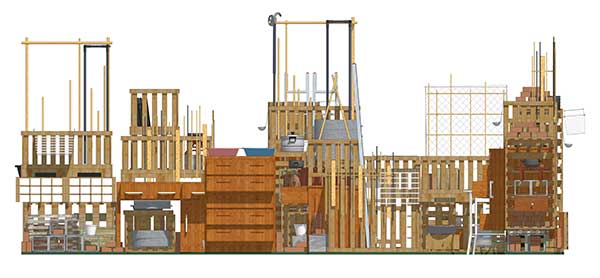
The Chinese pavilion at the Italian event will feature a project called Communal Garden in which designers work with residents of an old Beijing neighborhood to show the better use of space.[Photo provided to China Daily] |
"We should reduce waste, not manufacture more. We need to stop contaminating air, water and food when we seek larger apartments, more high-tech products and faster transportation."
Liang has chosen nine architects, designers and architect groups to show their works at the pavilion, in an effort to provide solutions for developmental issues in both cities and the countryside.
Their creations show various aspects of Liang's ideal of "daily Tao (Taoism)", using local material, craft and labor as a way to preserve traditions and save costs.
One case study being shown is the Maoping Village School in Central China's Hunan province designed by architect Wang Lu.
After the old school building was destroyed by rainstorms and mountain floods in 2006, Wang designed a new one, a two-story building that resembles a cluster of local houses and blends into its surroundings. Villagers participated in the construction to help lower the costs.
Wang, who revisited the school recently, says it is well maintained by students and teachers and looks just like when it was completed 10 years ago.
Ma Ke's Wuyong products will also be featured at the pavilion to emphasize that design and longevity are both central to the value of clothing.
The 45-year-old, who established the handmade, eco-fashion line Wuyong to help the revival of traditional craftsmanship through innovative design, operates two design centers - one in Zhuhai, in Guangdong province in the country's south, and the other in Beijing.
"A problem in the fashion industry is how to change people's ideas. Young people easily trap themselves in the pursuit of fashion. They keep on consuming and they keep throwing (clothes) away."
A native of Changchun, in Northeast China's Jilin province, Ma has vivid childhood memories of living in the countryside. She often spent her summer and winter breaks at her maternal grandmother's home. It kept her close to the Earth, and she feels fortunate as few people nowadays have similar experiences.
She regularly travels to rural areas seeking out handicraft techniques. She says in the countryside, people need very few outfits. She often hears them speaking with relish about an object, such as a chair that was made by someone's grandfather and has been used for years.
"Every article at home has memories and emotional attachments."
"While urbanities fill their homes with lots of stuff, people typically get rid of them before building a bond with them, thus making their homes boring," she says.
Liang also wears Wuyong creations because Ma says he can wear them for life and can send them to her workshops for maintenance.
Commenting on the current state of architecture in China, Liang says: "There has been a boom in architecture that costs a lot of money, looks sophisticated and fashionable. But it is embarrassing that few designs suit daily requirements.
"Only when we ensure that designs benefit common people can we revive the DNA of our culture and defend it," he says.

|
|
|
|
|
|
|
|
Copyright 1995 - . All rights reserved. The content (including but not limited to text, photo, multimedia information, etc) published in this site belongs to China Daily Information Co (CDIC). Without written authorization from CDIC, such content shall not be republished or used in any form. Note: Browsers with 1024*768 or higher resolution are suggested for this site.
License for publishing multimedia online 0108263 Registration Number: 130349 
















 Raymond Zhou:
 Pauline D Loh:
 Hot Pot
 Eco China
 China Dream
 China Face