 |
|
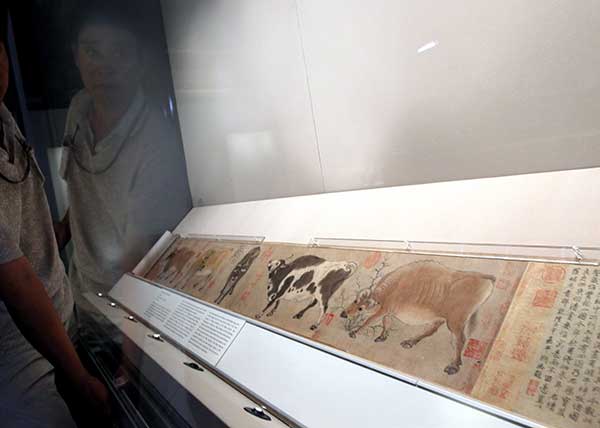
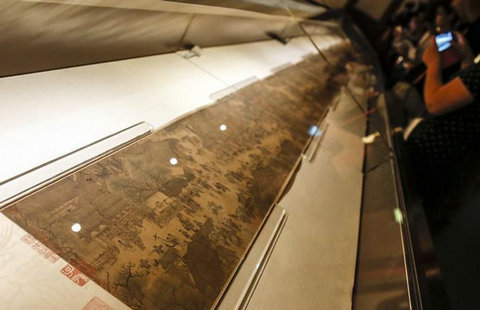
The painting Along the River During the Qingming Festival by Zhang Zeduan (1085-1145), will highlight the upcoming exhibition in Beijing's Palace Museum.[Photo by Jiang Dong/Wang Kaihao/China Daily] |
Anyone familiar with Chinese art who takes a brief stroll through the hall will spot many works they have encountered in the pages of textbooks. One such is Spring Excursion, by Zhan Ziqian (AD 545-618), one of the oldest surviving Chinese landscape paintings.
One of the works of calligraphy on display is Letter to Boyuan, a greeting by Wang Xun (AD 350-401) to an ill friend. It is the only surviving calligraphy from the Jin Dynasty (AD 266-420) with the writer's signature and is regarded as representing the apogee of Chinese calligraphic history. It is one of Emperor Qianlong's three favorite calligraphy works and once hung in his renowned Sanxitang study in the Forbidden City.
Those are just a few of the wonders on display, and the list goes on and on.
"The Stone Moat is like a jewelry box overflowing with gems," says Zhang Zhen, a researcher in the museum's painting and calligraphy department. "Seals on these works guarantee their royal identity.
"So we can be sure about how many imperial collections later dispersed in other directions, and that gives us a lot of help in retrieving them."
Social upheaval and war from the late 19th century to the early 20th century led to many works in The Stone Moat being looted and going overseas. When the Kuomintang retreated to Taiwan in 1949, a part was also taken there and is now housed in the National Palace Museum in Taipei.
The Palace Museum has taken three years to investigate their collections and makes a catalogue. About 1,000 pieces recorded in the book are now housed in the museum. Some works were donated or bought back, and for the exhibition a hall has been reserved for displaying these treasures.
One of these treasures is Five Oxen, another highly important work in the history of Chinese painting. It vanished after the Eight-Nation Alliance invaded Beijing in 1900 and surfaced again in the 1950s in Hong Kong. Premier Zhou Enlai put the Ministry of Culture in charge of negotiating to bring the painting home, and it finally returned to Beijing in the 1950s.
|
|
|
|
|
|
|
|
Copyright 1995 - . All rights reserved. The content (including but not limited to text, photo, multimedia information, etc) published in this site belongs to China Daily Information Co (CDIC). Without written authorization from CDIC, such content shall not be republished or used in any form. Note: Browsers with 1024*768 or higher resolution are suggested for this site.
License for publishing multimedia online 0108263 Registration Number: 130349 







 Raymond Zhou:
 Pauline D Loh:
 Hot Pot
 Eco China
 China Dream
 China Face