Bidding on change


 |
|
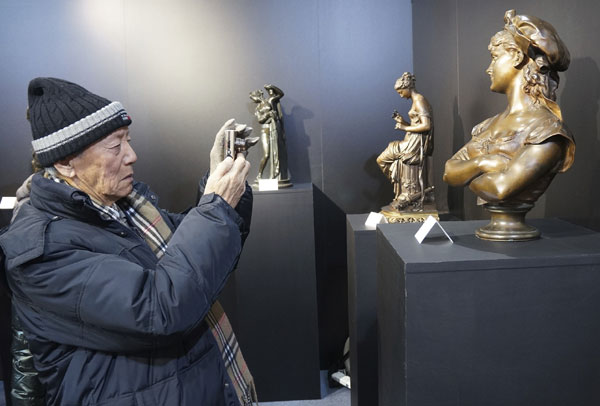
A man takes snapshots at the Beijing China Art International Fair in December last year, when China raked in 30 percent of the world's turnover of art and antiques, beating the US to become the world's No 1 market. Eighty percent of that volume comes from Beijing. Jules Quartly / China Daily |
China's first international auction puts on the block the opportunity for the industry to hammer out new national rules. Jules Quartly and Sun Li report.
China's first international auction in Xiamen signifies that curbs on the country's free trade of cultural artifacts may be going, going, gone. Huachen Auctions conducted the sale of 350 lots of Western art, furniture and silverware in Fujian province's free port, promoted by the online auction portal Epai Live and backed by the Association of Accredited Auctioneers (Triple-A), comprised of 21 British auctioneers. The April 21 sale is expected to open the door to more international auctions in China. It was also predicted that further government reform and the opening up of the market will overhaul regulations dating from New China's 1949 founding, preventing the sale abroad of "cultural relics" - which are, broadly speaking, antiques before 1911.
 |
| Art of urbanity |
As the world's second largest auction market, after the United States, the Chinese mainland registered more than 47.8 billion yuan ($7.8 billion) in art and antiques sales in 2012, according to the domestic auction-tracking company Artron. For market-tracking company Artprice, it is the world's largest art auction marketplace.
Even so, international auctioneers have been largely locked out of the trade, and there are concerns the market is not as free, transparent and trustworthy as other major international auction environments.
Simply put, this means that while Chinese are busy buying up treasures from abroad, it is not reciprocal - and, even if it were, there would be little confidence in the domestic market because of the amount of fakes washing around.