Ancient art given new life


 |
|
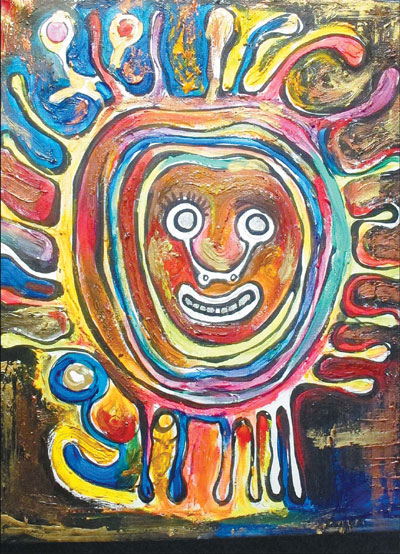
An oil painting displayed at the Grassland Culture Communication Center in Hohhot, the Inner Mongolia autonomous region. Photos by Wang Kaihao / China Daily |
The cliff paintings of the Yinshan Mountains represent thousands of years of history, and now an antique collector turned gallery owner is on a mission to honor their artistic legacy. Wang Kaihao reports from Hohhot.
Pilgrims to the lama temple Ih Juu in Hohhot, capital of the Inner Mongolia autonomous region, may not notice an old bookstore nestled in a corner of the square facing the place of worship. The bookstore's battered facade allows it to blend into the street, giving the impression it has stood there for many years. However, if visitors stumble upon the store and find their way up to the second floor, they will be amazed to discover a selection of fine arts.
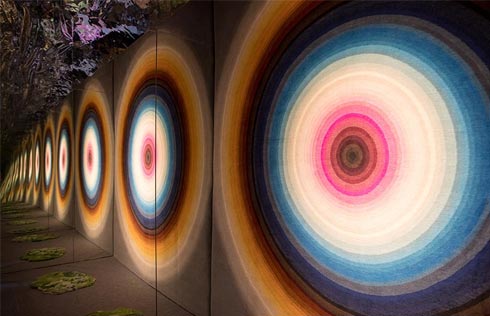
Dozens of colorful, flamboyant paintings line the corridors making the space look like something conjured up by Salvador Dali. But the paintings have not been collected only for their aesthetic beauty, but to preserve an important cultural tradition.
Hohhot-native Zhang Haibo, a 43-year-old of the Hui ethnic group, established the Grassland Culture Communication Center before this year's Spring Festival. He launched the project in an effort to revitalize the tradition of the ancient paintings that can be seen on the cliffs of the Yinshan Mountains.
Thousands of cliff paintings in Inner Mongolia's Bayannur provide a glimpse of nomadic people's life in Northern China dating from 10,000 years ago to the Yuan Dynasty (1271-1368), which was established by the Mongols.
Though they were first recorded in the 5th century, serious research on the paintings only began in the 1970s. Bayannur municipal government announced in late 2012 that the paintings are among China's new candidates for the list of UNESCO World Heritage sites.
"These cliff paintings are our lost collective memory," Zhang, once a successful antique collector, says. "The histories of Huns, Turks, Mongols and many other people are embedded there. As our country endeavors to make the cultural industry boom, I think it is time to do something more meaningful."
He gathered some local artists and asked them to use modern methods to create new works inspired by the simple lines and circles painted on the cliffs. He also invited about 10 artists from Mongolia and Russia to join his 30-strong artistic adventure squad, explaining the project "has to cross the national boundary for a creation that concerns the whole of the grassland".
|
|
|
| Chinese paintings on permanent display in UN | Zaire legacy |