Dance between the lines


 |
|
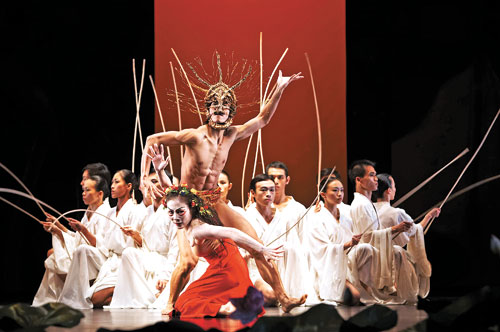
Nine Songs, a production by Asia's foremost dance company Cloud Gate, is a poetic tribute to those we should hold in reverence. Photo provided to China Daily |
To fully appreciate Nine Songs, audiences need to know more than the Chinese language and culture. Raymond Zhou reviews.
Lin Hwai-min's Nine Songs is more than a recreation of ancient rituals or an amalgam of pagan extravaganzas. It is a perfect fusion of the past and the present. As a matter of fact, it subtly portrays the progress of spiritual activities as refracted through the modern prism. Nine Songs was originally a cycle of poems by Qu Yuan, a poet of the Chu Kingdom who lived some 2,300 years ago, before China became a unified country.
|
|
| Dancing their way to higher education |
|
|
| Chinese and overseas arts serve and return |
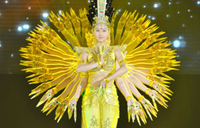

However, it did not seem to be the intention of the Cloud Gate founder and choreographer to faithfully recapture the content of the poem through the body language, but rather, he wanted to use it as a kind of springboard to pay tribute to all those whom we should hold in reverence.
Chinese, or Asians in general, do not worship only one god. We have all kinds of gods and goddesses. And you do not need to know who they are or what they do to understand the rites of each number. It takes an ethnologist or anthropologist to decipher the origin of each rite as Lin has taken liberally from all kinds of sources, including Taiwan indigenous tribes, cave carvings from Northwestern China, and harvesting celebrations from Indonesia.
The penultimate number does require some knowledge of the Chinese language and Chinese history as names are chanted out in Mandarin and Taiwanese dialect over a long sequence for which men and women are gagged and executed.
These are Chinese heroes who sacrificed their lives for the sake of their nation. We worship them in the same sense our ancestors worshipped their gods and goddesses. With one touch, Lin connected esoteric shamanism with the modern legacy that binds the Chinese people.
Artistically, Nine Songs is a calculated study in contrast. Ming Cho Lee's set design is uncharacteristically realistic - for a modern dance piece.
For one thing, there is a lotus pond downstage complete with water, well, actually outside the proscenium where the orchestra pit is. On top of that, rows of stage curtains on both top and sides are replaced with giant panels of lotuses, which are inspired by a lotus painting by Taiwan artist Lin Yu-san. The giant moon for the backdrop looks like it was lifted from a Broadway musical.
For more coverage by Raymond Zhou, click here