Designing the antidote to counterfeit culture
 |
|
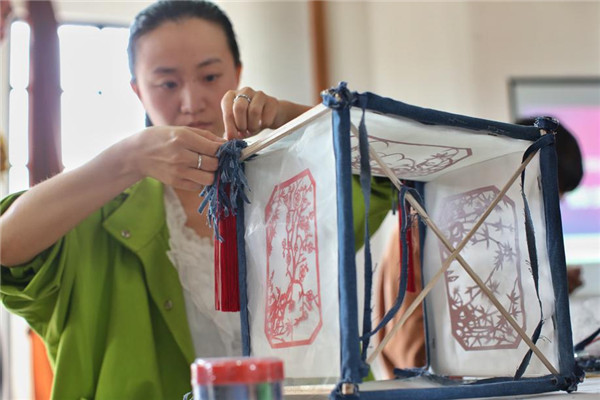
Zhang Jin, a student from Northwest Normal University in Lanzhou, Gansu province, makes a traditional Chinese lantern out of counterfeits. [Photo provided to China Daily] |
Six university students from around China had the chance to apply their creativity by turning knockoff goods into other types of useful products at a competition held at the East China University of Political Science and Law in Shanghai, as part of a novel program on how to dispose of seized fake products.
All the materials used by the students came from fake products amassed by e-commerce giant Alibaba, which organized the competition together with the China Youth Daily, China University Media Union and the Shanghai-based nonprofit organization Adream Foundation.
Since 2011, Alibaba has implemented spot checks on products sold on Taobao, the group's online shopping portal, and initiated corresponding sanctions for retailers who were caught selling counterfeits. These products are sealed up and stored for three years to be used as evidence in potential lawsuits, and those remaining after this time are destroyed.
"The traditional way that knockoffs are destroyed is also a way of waste of resources, and this was the reason the competition fascinated me," says Zhang Jin, a contestant and a first-year graduate student majoring in public art at Northwest Normal University in Lanzhou, Gansu province.
"We tried to change these products by peeling off their fake exteriors, and transform them into real products and make full use of these materials."
Sun Jungong, vice-president of Alibaba, says: "Fake goods are a kind of resources that are misplaced. Young people can give them another social value by repurposing counterfeit goods."
Voted by teachers and students on the scene, Ayjol Adli, an ethnic Kazak and a native of the Xinjiang Uygur autonomous region, won first prize with his creative work involving a pair of fake Nike sneakers.
He painted the shoes with patterns characteristic of his ethnic group, and used another fake Coach silk scarf to intensify its ethnic features. He says he cut the scarf into strips and glued them onto the front and sides of the shoes. He then shredded them with a knife to make them look and feel like fur.