China's desert warrior queen, defender of Dunhuang
 |
|
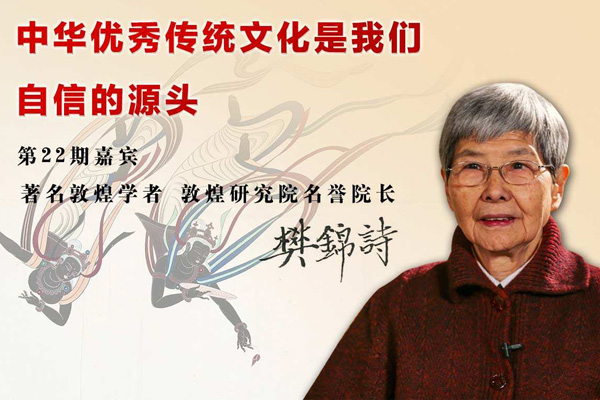
Fan Jinshi has spent half a century fighting an uphill battle to preserve the ancient Buddhist wall paintings at Dunhuang, Gansu province. [Photo/ccdi.gov.cn] |
If it had not been for Fan Jinshi and her team, the world cultural heritage at Dunhuang Mogao Grottoes in a remote Chinese desert might have long been destroyed by sand, weather or humans.
Born and raised in Shanghai, Fan has spent half a century fighting an uphill battle to preserve the ancient Buddhist wall paintings at Dunhuang, in Northwest China's Gansu province.
"It was not that I favored my job over my family, I just could not bear the guilt of having our ancestors' legacy destroyed," she told in Beijing while attending the annual session of the National Committee of the Chinese People's Political Consultative Conference (CPPCC).
The 1,600-year-old Dunhuang Mogao Grottoes are a huge collection of Buddhist art -- more than 2,000 Buddha figures and 45,000 square meters of paintings spread among 735 caves.
It is China's first UNESCO World Heritage Site.
Desert Warfare
Archaeologist Fan was sent to Dunhuang after graduating from Peking University in 1963. Her college sweetheart was assigned a teaching job in Wuhan, thousands of miles away.
While in Dunhuang, a desert outpost then, Fan lived in an abandoned temple. At first, she did not even dare go out to the toilet at night.
"I saw a pair of shining eyes in the dark. I thought it was a wolf," she said, before finding out that the eyes belonged to a donkey.
To protect the treasures from sand and dampness, Fan and other workers put doors on the caves, planted trees and started monitoring temperature and humidity in the caves. They also control the number of visitors.
"The carbon dioxide people exhale in the caves accumulates and will damage the paintings, so we allow a maximum of 3,000 tourists each day."
In the late 1990s, with tourism booming nationwide since national holidays were extended, the local government planned to go public with Dunhuang Mogao, but found Fan firmly in their way.
"The legacy would have been destroyed if it had been listed," she said.
The academy has now photographed and cataloged online all the sculptures and paintings. "Despite our efforts to minimize damage, we can't completely stop them from being eroded. But the digital database will last."
Fan was grateful when her husband joined her in Dunhuang in 1986 after 19 years of separation. Her two sons grew up in Shanghai with their aunt.
"I have not been a good mother or wife. With regard to my family, I'm full of guilt," she said.