Confucius depicted on mirror
 |
|
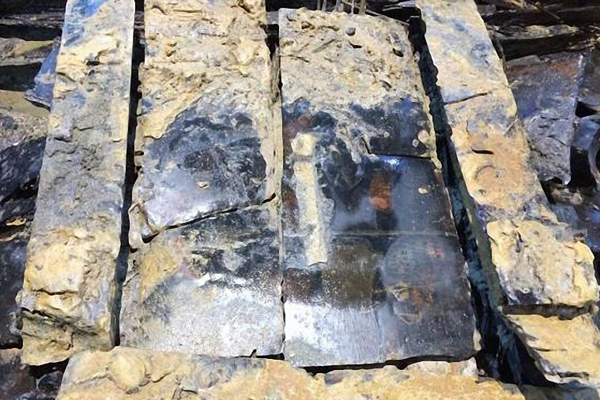
The bronze mirror that was unearthed in the tomb of the Marquis of Haihun. [Photo provided to China Daily] |
A polished bronze mirror unearthed in China's most complete Western Han Dynasty (206 BC-AD 24) cemetery bears the earliest known image of Confucius, while the writing on it may offer more information about the educator and philosopher who lived about 2,500 years ago, an archaeologist said on Monday.
The mirror, mounted on painted wood, was discovered in the tomb of the Marquis of Haihun. It is nearly 1 meter in height and has a painted wooden cover and holder. Confucius is depicted on the cover dressed as a commoner. Images of two of his students are also on the cover, said Yang Jun, head of the tomb's excavation team.
Also on the painted wood are almost 2,000 Chinese characters, written in ink, that tell stories about Confucius and his students.
The mirror doubled as a folding screen, Yang said.
The mirror is believed to have been used by Marquis Liu He, the grandson of Emperor Wu.
The stories about Confucius and his students would likely have been written by some masters of Confucianism who were Liu's teachers, Yang said.
However, that information is not the same as that found in Records of the Historian, written by Sima Qian during the Western Han Dynasty, he said.
Archaeologists began to excavate the tomb in 2011, and the remains of the marquis were removed for research in January last year. The burial chamber, near Nanchang, the Jiangxi provincial capital, covers about 40,000 square meters and is one of the few imperial tombs that have not been looted. It contains eight small tombs and a burial site for chariot horses.
Among the greatest archaeological finds made were 285 gold ingots, 48 gold horse hoofs, 25 gold hoofs of qilin (a mythical animal) and 20 gold plates.
Archaeologists also found a bronze pot containing chestnuts, possibly a sign that China's hotpot cuisine was also popular among ancient aristocrats.
During the excavation, care was taken to preserve the site, and an application has been submitted to include it on the UNESCO World Heritage list.
Confucius, who lived from 551 BC to 479 BC, was an educator and philosopher whose teachings have influenced generations of Chinese society.
Related:
Qi version of 'Analects of Confucius' discovered in Haihunhou tomb
Story of shortest reigning emperor to hit big screens in 2018