Ancient art returning home
 |
|
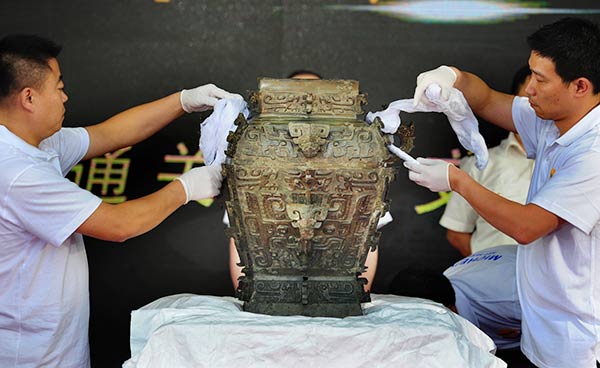
Workers inspect the Min Fanglei, a 3,000-year-old bronze wine vessel, in 2014. The vessel was to be reunited with its lid after being separated for about 90 years. It was unearthed in the Hunan province in the 1920s and was traded abroad. Guo Liliang/China Daily |
Bronze wine vessel a success story; other treasures defy looting definition
When a 3,000-year-old bronze wine vessel was shown at an exhibition in Shanghai last year, it drew a large number of viewers.
A year before that, the ceremonial vessel, known as the Min Fanglei, returned to its birthplace in Central China's Hunan province to reunite with its lid after being separated for about 90 years.
Unearthed around 1922 by a villager, the vessel was the subject of several transactions. It was traded abroad and changed hands among dealers and private collectors.
The lid has been at Hunan Provincial Museum in Changsha since the 1950s.
The vessel was scheduled for a Christie's auction in New York in April 2014. A group of Chinese buyers from Hunan acquired the bronze in a closed-door deal with its European owner on the condition that it would be donated to the museum. The price was reportedly in the millions of US dollars, but the exact figure was not revealed.
Tan Guobin, one of the Chinese buyers, told China Daily after the deal that the transaction price was thought to be lower than bids would have been if the auction had proceeded.
The return of the bronze is an example of public institutions and private collectors working together to bring Chinese cultural relics back home.
The past five years have seen an increase in the number of Chinese buyers bidding for Chinese antiques at major auctions in New York, London, Paris and elsewhere. Their participation in the global art market has not only pushed up the prices of Chinese art, but has also drawn government and public attention to lost treasures.
A ban by the State Administration of Cultural Relics on the auction of stolen, smuggled or looted cultural relics underscores the official stance denying the legitimacy of such commercial transactions. One result is that Chinese buyers may become more cautious when making bids overseas.
Ji Tao, an art market researcher at Central University of Finance and Economics in Beijing, said the administration needs to further clarify what "looted" artifacts are.
Some objects remain with the offspring of those who took them, while others have been traded numerous times and have been acquired by their current owners through lawful deals, he said.
He added that looted objects, such as those robbed from Beijing's Old Summer Palace by British and French forces during the Second Opium War, account for a small part of the Chinese antiques available on the international market. The bulk were exported through legitimate transactions.
Many Chinese artifacts that were stolen are part of museums and galleries worldwide. Unless they are offered at auction, their return home is highly unlikely, Ji said.