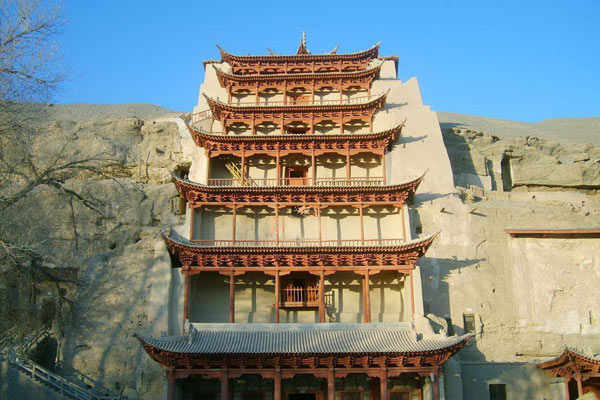
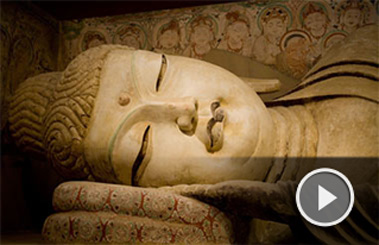
The Mogao Grottoes, also known as Thousand-Buddha Caves, are located on the eastern foothills of the Mingsha Mountain, 25 kilometers southeast of the town of Dunhuang. The site is one of the largest, best-preserved and richest treasure houses of Buddhist art in the world. The first cave was built by a travelling monk, Le Zun, in 366.
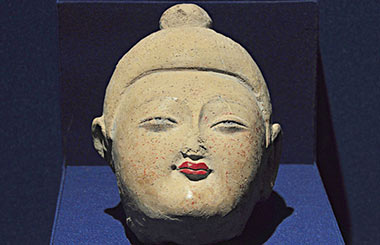
735 caves dug out of a 40 meter high cliff face stretching 1,700 meters long from south to north still survive today. The grottoes contain approximately 45,000-square-meter wall paintings, more than 2,000 painted sculptures and five wooden temple facades from the Tang and Song Dynasties. In 1900 the Taoist abbot Wang Yuanlua discovered the Library Cave (Cave 17) that contained a priceless collection of over 50,000 artifacts, including manuscripts, Buddhist sutras and silk paintings dating back from the 4th to the early 11th century.
The Mogao caves and the artifacts reflect the development of sculpture and wall paintings in China over a thousand year period. The caves are a source of detailed information on many areas including the evolution of the dissemination of religious beliefs, relationships between different ethnic groups within China, connection between China and the west, Chinese society and daily life, folk customs, technology, architecture, clothing, and military ordinances. These artifacts have important historical, artistic, scientific and social values.
 |

Copyright 1995 - . All rights reserved. The content (including but not limited to text, photo, multimedia information, etc) published in this site belongs to China Daily Information Co (CDIC). Without written authorization from CDIC, such content shall not be republished or used in any form. Note: Browsers with 1024*768 or higher resolution are suggested for this site.
License for publishing multimedia online 0108263 Registration Number: 130349 









 Raymond Zhou:
 Pauline D Loh:
 Hot Pot
 Eco China
 China Dream
 China Face