 |
|
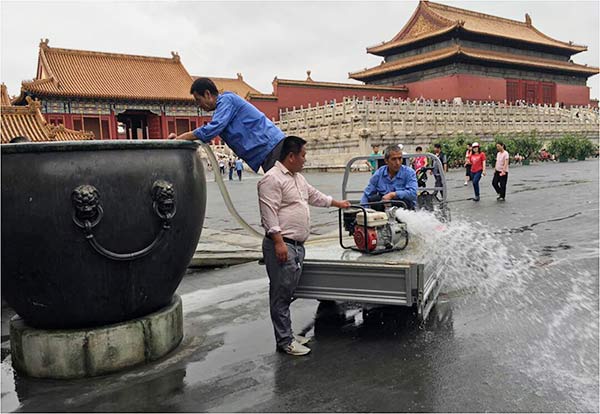
Rainwater is pumped out of a jar in the Forbidden City after heavy downpours in Beijing last week. Provided To China Daily |
Complex drainage system at Forbidden City shows how to keep water away during a storm
When media published a set of photos showing the 600-year-old Palace Museum, or Forbidden City, free of floods despite the heavy rain on July 20, online discussions quickly followed.
Netizens were impressed by the old complex's drainage ability and compared the pictures with other photos and videos showing many flooded roads within Beijing after the tremendous downpour.
The ancient drainage system still functions well and has worked with modern systems to keep the palace safe from floods, according to Shan Jixiang, curator of the museum.
"The ancient drainage system in the Forbidden City symbolizes a spirit of craftsmanship that has been passed down for generations. However, the palace's drainage and flood-prevention ability today is the result of many factors," Shan said at a news conference on Monday.
Built during the Ming Dynasty (1368-1644), the Forbidden City has been well maintained over the past few centuries. Painstaking design, measurement and execution were all part of the construction, according to Shan.
Three types of drainage systems - for buildings, surface runoff and underground - make up the system at the site.
The nearly 2-meter altitude difference between the 46.05-meter north gate (Gate of Divine Might) and the 44.28-meter south gate (Meridian Gate) of the museum created favorable conditions for natural drainage.
The palace's three front halls are built on three steps whose drainage holes at their bases prevent the steps from flooding. Every garden and courtyard has both open and blind drainage pipes. The gardens are also higher in the middle and lower on either side to facilitate water movement.
Artificial drainage systems, including ditches, culverts and drain holes complete the network. The ancient drainage system, which accounts for more than 90 percent of the total, is both huge and complex. Culverts alone add up to nearly 13 kilometers, Shan said.
"We're fully aware of our responsibility to protect the heritage, and have carried out a series of research and protection projects to maintain and rejuvenate the palace's drainage functions," he said.
Studies and monitoring have been carried out to see if the old system will be able to continue meet the weather challenges.
Shan said museum staffers divided the system according to different zones of the palace and made plans to thoroughly flush it out over the next five years. For example, dredging the blind underground pipes of the royal garden at the northern section is an important task.
The museum has upgraded the Forbidden City's drainage system to meet new challenges. For example, the system can separate rainwater from sewage, a problem brought every day by the numerous tourists.
The museum has also made plans to deal with floods or emergency situations that may require the evacuation of visitors, Shan said.
Chen Liubing contributed to this story.

Copyright 1995 - . All rights reserved. The content (including but not limited to text, photo, multimedia information, etc) published in this site belongs to China Daily Information Co (CDIC). Without written authorization from CDIC, such content shall not be republished or used in any form. Note: Browsers with 1024*768 or higher resolution are suggested for this site.
License for publishing multimedia online 0108263 Registration Number: 130349 












 Raymond Zhou:
 Pauline D Loh:
 Hot Pot
 Eco China
 China Dream
 China Face