 |
|
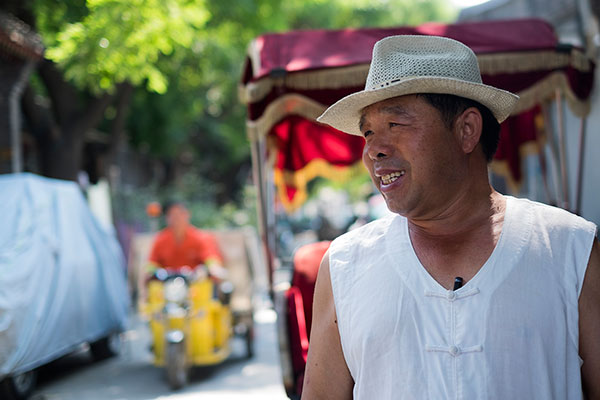
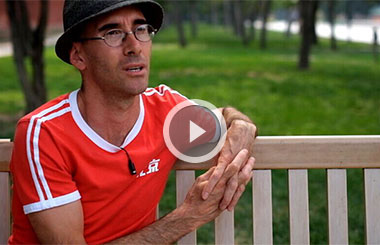
As a rickshaw driver in the hutong, Xin Ying Wu witnessed the rise of modern commercialization first-hand.[Photo provided to chinadaily.com.cn] |
The impact of change
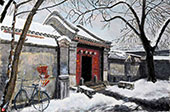
Though they are ancient and traditional, those living in the hutongs have seen an immense amount of change within their lifetime.
In about the last decade, a new force of change has been altering the hutong. Suddenly, some areas, like Nanluoguxiang, became trendy among foreigners, tourists, and local Beijing residents.
"The impact is pretty big, because the development has made Nanluoguxiang become what it shouldn’t be," said Xin Yingwu, a tricycle driver and hutong resident for 26 years. “It is a really old alley, dating to the Yuan Dynasty. At that time, it was a residential area, and even some officials like emperors lived there. Because Nanluoguxiang is not what it used to be, the impact of commercialization is really strong now. Things like restaurant streets should be in a commercial area, but not in a residential area. Because there are way too many food places, the lives of residents there have been influenced a lot. The culture is not been what it used to be.”
The increase of shops and businesses has had a lasting effect on residents. Yang, the tour manager from China Highlights, said that residents are inconvenienced by the noise and influx of tourists, and some have even found the areas unsafe.
As commercialization speeds forward in these areas, many residents are moving out.
"As it's built in popularity, and more cafes and more shops and more bars have moved into the area, the residents have for one reason or another, not forcibly, but probably by choice, just moved out," McCrohan said. "They’re able to charge high rents on their front rooms to a shop-owner, so why still live there, when you can go move into an apartment and earn loads of money from a shopkeeper who can then sell his goods for a lot of money because it's in this fabulously popular street."
Despite the impact on hutong culture, commercialization has had some benefits. Demolition efforts have been halted in popular areas, and the renewed outside interest in the hutong has led to renovation projects that aim to improve the living conditions.
Still, McCrohan said, at the end of the day, the most important part of the hutong is the people who live in them, and continue to pass on hutong culture.
"The problem is, when they get that successful, those particular hutongs lose their essence, which is what made them really interesting in the first place. In that, there are no longer any residents living in them, or very, very few," McCrohan said. "And so you don't get that village vibe. It ends up being that the only attraction is the architecture. But of course, a hutong is a lot more than just its courtyards. It's the fact that people are living in them, and that they have a neighborhood feel to them."

Copyright 1995 - . All rights reserved. The content (including but not limited to text, photo, multimedia information, etc) published in this site belongs to China Daily Information Co (CDIC). Without written authorization from CDIC, such content shall not be republished or used in any form. Note: Browsers with 1024*768 or higher resolution are suggested for this site.
License for publishing multimedia online 0108263 Registration Number: 130349 





 Raymond Zhou:
 Pauline D Loh:
 Hot Pot
 Eco China
 China Dream
 China Face