 |
|
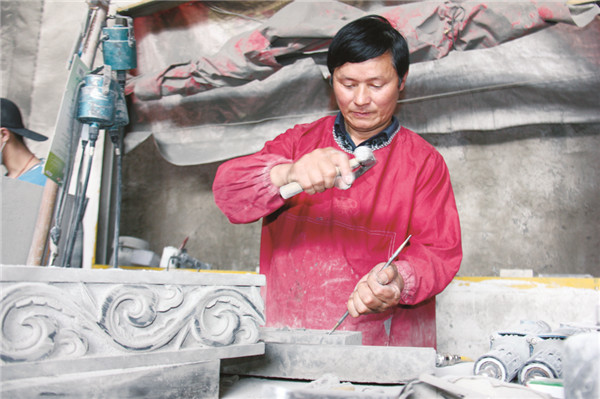
Brick carver Wu Linshui at work in his workshop in Huangshan city of Anhui province. Brick carving works are often used to decorate ancient-style architectures. ZHU LIXIN / CHINA DAILY |
Also known as Huizhou Prefecture, Huangshan is today widely associated with being the home of the picturesque Huangshan Mountain, or Yellow Mountain.
What many people are not aware of, however, is that the city is also renowned for its carvings, be it wood, stone or brick.
"The furniture made by the local craftsmen of Huangshan have always been famous in the country", said Chen Wenyuan, an expert from the Huangshan-based Anhui Research Center of Intangible Culture Heritage.
In fact, the ancient architecture in Huangshan’s old villages is so well-preserved that one may feel that he or she has travelled back in time when strolling through these settlements.
Many of these ancient buildings were built by a group of successful businessmen called the Huizhou merchants who made their fortune by trading tea and salt in the country. It is believed that these merchants accounted for almost half of China’s wealth between the late Ming Dynasty (1368-1644) and the early Qing Dynasty (1644-1911).
Becoming a businessman was a common thing in Huizhou during those ancient times — more than 70 percent of local male residents had their own businesses — as the mountainous region had very few farmlands. Furthermore, it was one of the country’s most important transportation hubs as it connected the provinces of Anhui, Zhejiang and Jiangxi.
Chinese people are known for their affections toward their birthplaces and the Huizhou merchants were no different. Many of them started constructing buildings in their hometowns and these structures would be seen as a symbol of pride. The merchants took great care in ensuring that these buildings bore exquisite craftsmanship in the form of brick carvings at the entrances, stone carvings at various windows and wood carvings for door frames.
The carvings seen in Huizhou span a wide range of imagery, including birds and flowers, auspicious beasts such as dragons or lions, characters from folklore, scenes of nature as well as daily activities such as water gathering, farming and reading.
These works were the most time-consuming part of building a Huizhou-style building. The construction of an ancestral temple often took generations to complete. Today, these three types of carvings have been classified as a national intangible cultural heritage by China’s authorities.
zhulixin@chinadaily.com.cn

Copyright 1995 - . All rights reserved. The content (including but not limited to text, photo, multimedia information, etc) published in this site belongs to China Daily Information Co (CDIC). Without written authorization from CDIC, such content shall not be republished or used in any form. Note: Browsers with 1024*768 or higher resolution are suggested for this site.
License for publishing multimedia online 0108263 Registration Number: 130349 







 Raymond Zhou:
 Pauline D Loh:
 Hot Pot
 Eco China
 China Dream
 China Face