 |
|
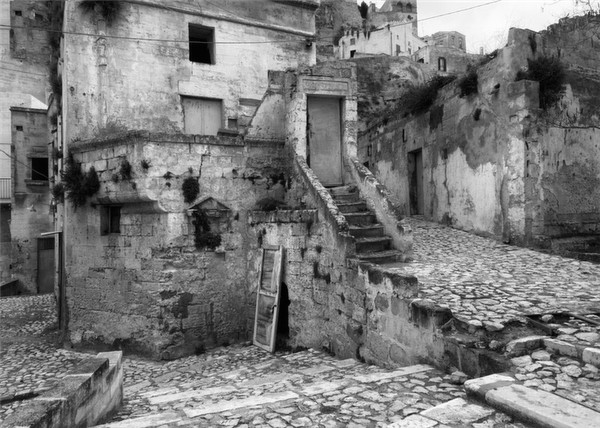
Door ruins in Matera. [Photo/bretculp.com] |
What was Matera like ten years ago? Why were people moving away from Matera?
Matera, in the South Italy, is a primordial dwelling settlement based on cave-houses that were carved in the stones and therefore called the "Sassi" (rocks). In the 1950s this way of living was considered inacceptable modern living. The Sassis of Matera was declared a national shame and 20,000 inhabitants were forced to move to new quarters. The abandoned houses became State property and were boarded up in order to prevent people from living in caves.
Consequently, the Sassi of Matera became a desert town; the largest historic center of Europe that was completely abandoned. The dwellings not inhabited and aired underwent a rapid degradation process as well as the rock–hewn churches which boasted beautiful medieval frescoes.
Since when did Matera start being valued and preserved? And what measures have been taken to make this work?
It started after the mass migration of the inhabitants of the rock dwelling city of Sassi di Matera. In the 1980s, there was an emergence to preserve it, but no one seemed to see how.
Some wanted to leave the site as it was, abandoned, which would have been a testimony of what had happened in the past. Others proposed to make the dwellings inhabitable again with a bold effort to reclamation by rehabilitating all necessary transformations.
In the first option, the Sassi of Matera would have remained deserted. Essentially it would have been a museum city, impossible to preserve. In the second option, the reclamation would have involved demolition and reconstruction. The solution would have only been achieved if the inhabitants returned after the necessary restorations compatible with the preservation of its character.
Finally, we used the UNESCO principles. The landscape is build by the people; it is a balance of nature and culture. It is movement and change. It is not possible to keep the landscape as a museum. But it is necessary to propose those changes in harmony with the historical evolutionary process.

Copyright 1995 - . All rights reserved. The content (including but not limited to text, photo, multimedia information, etc) published in this site belongs to China Daily Information Co (CDIC). Without written authorization from CDIC, such content shall not be republished or used in any form. Note: Browsers with 1024*768 or higher resolution are suggested for this site.
License for publishing multimedia online 0108263 Registration Number: 130349 








 Raymond Zhou:
 Pauline D Loh:
 Hot Pot
 Eco China
 China Dream
 China Face