|
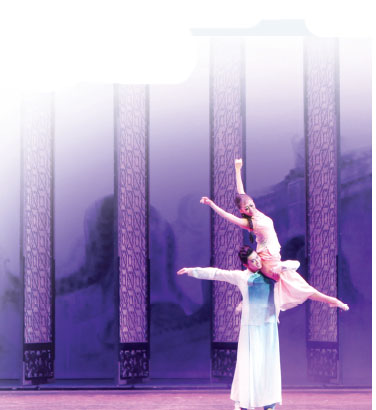
Above and below: The dance drama Dragon Boat Racing was staged at Lincoln Center in New York by the Guangdong Song & Dance Ensemble on Jan 7. photos by Hong Xiao / for China Daily |
'Incredibly talented'
"China's artists are incredibly talented, but without professional producers to be the managers, organizational brains, and bridges to the rest of China's growing market and out into the world, those talented artists will stay talented but locked in their own little studios," she said.
"So the next stage is not just to keep encouraging diverse individual artistic voices to flourish in China, but also to develop the producers and infrastructure to support those artists to reach more and more audiences, both in China and the rest of the world," she said.
According to many US experts, "presenter" agencies are the best way into the US market.
They represent artists searching for an agent, companies searching for performers and facilitate exchanges between artists and audiences.
The Association of Performing Arts Presenters (APAP), the largest organizing body of performing arts presenters in the US, held its annual conference in New York City in January.
Attending this year was a Chinese delegation consisting of more than 50 managers and directors of 10 national troupes and seven provincial troupes and ensembles, including the China National Peking Opera Company, China National Opera & Dance Drama Theater, the China National Symphony Orchestra, the China National Opera House, as well as booking agents, venue reps and presenters from across China.
The Chinese delegation not only exhibited their productions in booths, but also invited American arts alliances, booking companies and presenters to attend a promotional seminar on Chinese performing arts and discuss building marketing channels for international cooperation.
Wang, who attended the APAP conference, thought the opportunities for China's performing arts were still limited, so the number of deals reached by the two sides was relatively small.
Wang suggests that because the conference is an occasion for closing deals rather than reaching deals, the Chinese delegation should have been better prepared.
Wang said for most of the delegation, it was their first time to attend the conference. "They had language difficulties and few contacts, so the productivity was quite low. Before coming overseas to a conference like APAP, we should have a planning meeting at home to coordinate a strategy, make appointments with high-level potential partners in the US, and then attend the conference as a group. That would help us break into the circle faster."
Friedman said a big part of her job is educating US presenters about the diversity of contemporary Chinese art and presenters in the US, much like presenters in China, are worried their audiences aren't open to certain international art forms.
But "I've found the opposite is true," she said. "Audiences are open and ready, but you need to communicate very clearly what it is you're bringing."
Productions like Peking Opera megastar Zhang Huoding's performance last September at Lincoln Center, the concert Rediscover Chinese Music at Kennedy Center last December and the January production of the dance drama Dragon Boat Racing at Lincoln Center, all won enthusiastic receptions from US audiences. The last performance of Dragon Boat Racing was sold out.
'It indicates the performance quality has improved, marketing methods have grown more mature and getting closer to Western audiences' tastes,' said Winston Wang, deputy director of cultural exchange division of China Performing Arts Agency (CPAA). 'There has been a great increase in the number of China's performing arts products exported in the past few years.'
Wang's group used to dominate the market, but with China's administration being simplified and power and decision-making percolating down to lower levels, it is no longer performing arts' only door to the outside world.
Many organizations and companies, whether government operated or private, have been evolving in the industry, with more performing arts troupes assigned overseas, 'which is a good sign', Wang said.
'The exchange has expanded a lot in both number and range,' said Zhou Wei, president of Weiber Consulting, a New York-based marketing and public relations firm with experience working in Chinese and Asian markets.
The company's recent projects include bringing the National Ballet of China to perform at the 2015 Lincoln Center Festival and producing the New York Philharmonic Chinese New Year's celebration concert.
'But it's a fact that no matter what level the performance is, it cannot survive without government support. Dragon Boat Racing had support from the Guangdong provincial government and The Legend of Mulan from the Hong Kong (SAR) government,' Zhou said.
She said that to supplement government help, Chinese producers are looking for overseas partners.
In 2014, China National Center for the Performing Arts Orchestra (CNCPAO) made its North America debut in major concert venues in Chicago, Washington, New York, Philadelphia, Ottawa, Toronto and Montreal.
They did it with the help and guidance of the Philadelphia Orchestra and the Chicago Symphony Orchestra, which had previously collaborated with the CNCPAO on China tours. 'Such exchanges and cooperation between orchestras, dance companies and arts festivals of the two countries are common,' Zhou said.
- Niu Yue
Copyright 1995 - . All rights reserved. The content (including but not limited to text, photo, multimedia information, etc) published in this site belongs to China Daily Information Co (CDIC). Without written authorization from CDIC, such content shall not be republished or used in any form. Note: Browsers with 1024*768 or higher resolution are suggested for this site.
License for publishing multimedia online 0108263 Registration Number: 130349 








 Raymond Zhou:
 Pauline D Loh:
 Hot Pot
 Eco China
 China Dream
 China Face