 |
|
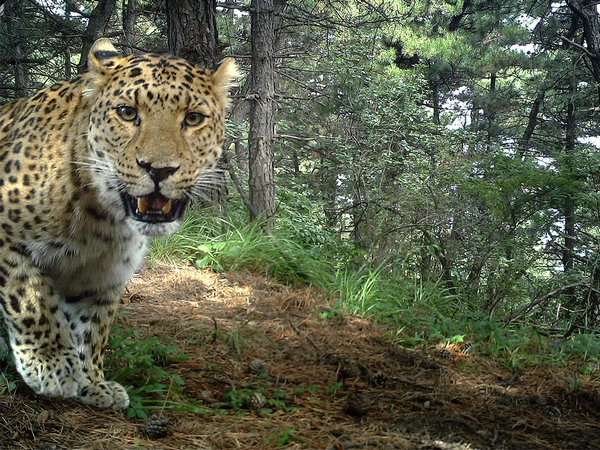
Images of wild leopards are captured by infrared cameras in the Taihang Mountains in Shanxi province.[Photo provided to China Daily] |
So how do they prepare for a project?
For starters, they begin by observing the landscape and the vegetation of the area to learn about the habitat via Google Earth.
Then, they visit villages nearby to rub shoulders with locals and gather information about the leopards.
Finally, they go into the mountains to collect evidence such as feces and footprints of the animals to decide where to place the cameras.
In the past few years, the CFCA found evidence that there were more than a dozen leopards in the area.
Although the CFCA is striving to help protect the leopards, Wan and Song regret that while they have seen many wild animals they have never spotted a leopard.
The closest they came to seeing one was once when they had just finished setting up an infrared camera.
A leopard appeared at the spot soon after they had left the area and peered into the camera curiously.
"As the king of the woods, it (the leopard) is aware of everything happens in its dominion," says Wan.
Despite its small numbers, the CFCA does not let size come in the way of its ambitions.
As of now, they have hired five locals in Shanxi to promote the importance of protecting leopards, to patrol the mountains, to collect data regularly from infrared cameras and report poachers to the police.
"Our members often go into the mountains and they have seen leopards several times. Nothing dramatic happens when they spot the animals because leopards typically don't attack human beings," says Wan.
"But leopards do prey on livestock. So it is urgent to tackle this conflict to avoid someone poisoning the leopards in revenge."
In 2013, the CFCA started to investigate the loss of cattle in Shanxi province and launched a compensation program last year.
There were 44 confirmed cases of livestock loss and they paid out a total of 64,000 yuan ($9,700).
When a villager reports a cattle death, the CFCA's local members confirm whether it has been attacked by a leopard.
The standard compensation is between 800 yuan and 3,000 yuan depending on the animal's weight, but it's just about a fifth of what the animal is really worth.
"It's only a psychological comfort. The farmers are honest and impoverished, and most of them support what we're doing," says Song.
According to him, though the government has built cattle pens in the village, farmers prefer to leave their cattle on the mountains most of the time.
And though grazing is prohibited in the area it's not easy to keep farmers from accessing the site as farmers save money by letting the animals graze on the mountains and it also gives them time to do other jobs.
"It (the issue) is complicated. And, while compensation is not a lasting solution, our final aim is to work with the local government to get all the cattle out of the mountains, or establish a fenced grazing area," says Song.
In 2015, the CFCA's investigations in a village in Sichuan province showed more than 40 heads of cattle and horses had been killed by leopards.
The area where the animals were said to have been killed is legal grazing ground so the CFCA plans to work with the government to have a pilot compensation project introduced there.
Copyright 1995 - . All rights reserved. The content (including but not limited to text, photo, multimedia information, etc) published in this site belongs to China Daily Information Co (CDIC). Without written authorization from CDIC, such content shall not be republished or used in any form. Note: Browsers with 1024*768 or higher resolution are suggested for this site.
License for publishing multimedia online 0108263 Registration Number: 130349 














 Raymond Zhou:
 Pauline D Loh:
 Hot Pot
 Eco China
 China Dream
 China Face