 |
|
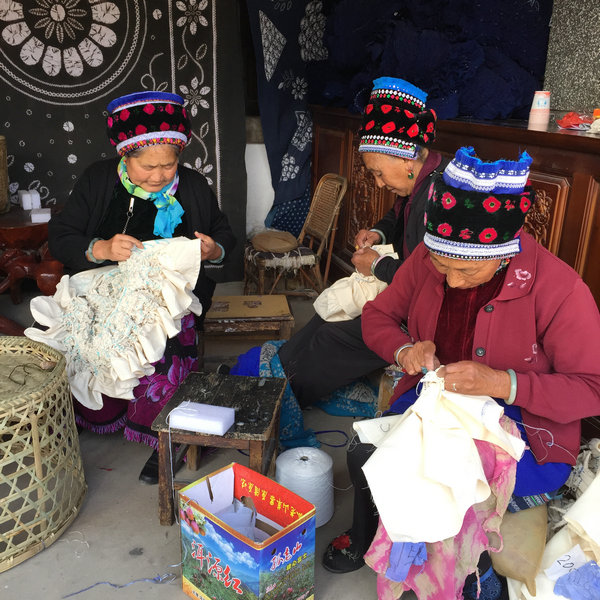
Local women work in a tie-dye workshop in Zhoucheng village, in Yunnan province. The craftsmanship is a cultural treasure.[Photo by Yang Feiyue/ China Daily] |
The Puzhen tie-dye workshop in Zhoucheng village doesn't have any modern machinery despite being one of the largest such operations in Yunnan province's Dali area.
On a recent day, a few big wooden buckets filled with dark blue liquid are seen in the front yard of this workshop in Southwest China.
Here, clothes in floral patterns flutter in the wind from ropes attached to poles as a bunch of elderly women in colorful traditional hats sew sheets.
"When you look at pieces of cloth under the sun, you will notice countless needle holes in them," says workshop owner Duan Shukun. "That can only be realized by hand. Machines won't do."
Although similar artisans can be found in the provinces of Guizhou, Jiangsu and Sichuan, women from practically every household in Zhoucheng are involved in making tie-dye clothes. Some 6,000 people of the village's 10,000 residents are employed by a few dozen tie-dye cloth producers in Zhoucheng.
The handicraft with local ethnic elements requires at least eight stages of delicate work and was named a national intangible cultural heritage in 2006.
At first, floral patterns are drawn on plastic sheets, then a tool resembling a needle is used to puncture the edges of the patterns. Then the punctured sheet is placed on white cloth and plastered with paint that percolates into the cloth. The resulting impression of floral patterns is then highlighted with dots in the cloth. A plastic sheet can be repetitively used as a mold.
The artisans then use needles and threads to tie up the dots into myriads knots before dipping the cloth in dye, mostly made of isatis roots.
When the cloth is taken out of the dye, the tied parts remain in their original white color while the rest is dyed, with various images also formed. A piece of cloth is dyed about three times a day for four days before the entire process ends. Tying up the knots is the most important and difficult of all the steps.
"A slight difference in the way a knot is made will result in subtle changes in the final image," Duan says.
Copyright 1995 - . All rights reserved. The content (including but not limited to text, photo, multimedia information, etc) published in this site belongs to China Daily Information Co (CDIC). Without written authorization from CDIC, such content shall not be republished or used in any form. Note: Browsers with 1024*768 or higher resolution are suggested for this site.
License for publishing multimedia online 0108263 Registration Number: 130349 







 Raymond Zhou:
 Pauline D Loh:
 Hot Pot
 Eco China
 China Dream
 China Face