While Chinese writer Lao She (1899-1966) is known as an accomplished novelist and playwright, few know about his contribution to Quju, a traditional opera, which is believed to be the only local opera in Beijing.
In 1952, Lao She wrote a play, The Willow Well, and called it Quju, which was based on Beijing's local Quyi opera.
Since the Beijing Quju Opera Troupe was founded in 1959, nearly 10 of his works have been adapted into Quju opera, including Rickshaw Boy, Teahouse and Four Generations under One Roof.
The works are known for their depictions of Beijing culture, especially the use of Beijing slang and the portrayal of ordinary people.
During the upcoming Chinese Lunar New Year, or the Spring Festival, which falls on Feb 8 this year, the troupe will perform two shows in the capital. Fang Zhenzhu and Zheng Hong Qi Xia (Beneath the Red Banner) are both adapted from Lao She's novels of the same name.
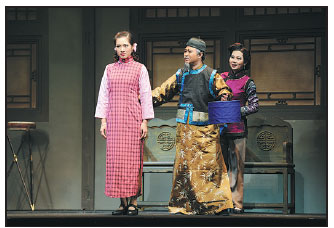
Fang Zhenzhu, written in 1950, tells the story of a group of folk artists and their predicament in a turbulent society before and after the founding of New China in 1949.
The troupe first staged the work in the early 1980s. Then, last year, the company staged the work for the first time in more than 30 years.
While keeping to the original storyline, veteran composer Dai Yisheng and director Zhang Shaorong adjusted the singing and acting, and simplified the relationships between the characters.
The lead character is a Beijing folk artist who plays the jingyun dagu (ballad-singing drumbeat performances popular in Beijing).
Beneath the Red Banner, written by Lao She over 1961-62, is the writer's unfinished autobiographical novel.
Lao She, who was born Shu Qingchun in Beijing, was of Manchu descent.
In the novel, he tells of the life of the Manchurians in the late Qing Dynasty (1644-1911).
Sun Dongxing, director of the troupe, says: "The greatness of Lao She lies in his deep understanding and portrayal of human nature as well as traditional Beijing culture. There is always something connected to our lives through his works."
Sun adds that every year the company celebrates Lao She's birthday on Feb 3 by performing his works during the Spring Festival.
The writer committed suicide during the "cultural revolution" (1966-76).
Sun also says that the company will mainly use young Quju opera actors in Beneath the Red Banner.
Besides the two works adapted from Lao She's novels, the troupe also plans to present Huang Ye Hong Lou, a Quju opera developed by the company in 2013.
It tells the story of Cao Xueqin, a Chinese writer during the Qing Dynasty, who produced his best work, A Dream of Red Mansions, from Beijing's Huangye village, which is located at the base of the Fragrant Hills.
The opera has been performed more than 50 times and has won national awards.
Nowadays, many voices lament the decline of traditional Chinese art forms, such as Peking Opera and other local folk operas, including Beijing's Quju. But 20 years ago, the company was on the verge of dying because of a paucity of young talent and lack of commercial viability.
However, thanks to Snuff Bottles, a Quju opera work by composer Dai and scriptwriter Zhang Yonghe, the company not only survived but also drew audiences back.
The show, which tells of the miserable life of a skilled craftsman who would rather cut off one of his arms than make a snuff bottle bearing the image of a foreign invader, has been performed nearly 400 times and has been viewed by around 170,000 people.
As for the future, Li Xiangkui, one of the actors in his 30s, describes it best when he says: "Young audiences have the impression that folk operas are outdated and something very old. But when we perform at universities in China, especially in Beijing, the students like it and are curious about it.
"I don't think the audiences have any barriers when it comes to understanding the art form."
And as Dai, 73, a veteran composer, who had been with the troupe since 1972, says: "We devoted our lives to Quju and we don't want it to die."
|
A scene from Fang Zhenzhu, a Quju opera adapted from Lao She’s novel of the same name. Provided To China Daily |
(China Daily 01/20/2016 page18)
Copyright 1995 - . All rights reserved. The content (including but not limited to text, photo, multimedia information, etc) published in this site belongs to China Daily Information Co (CDIC). Without written authorization from CDIC, such content shall not be republished or used in any form. Note: Browsers with 1024*768 or higher resolution are suggested for this site.
License for publishing multimedia online 0108263 Registration Number: 130349 





 Raymond Zhou:
 Pauline D Loh:
 Hot Pot
 Eco China
 China Dream
 China Face