 |
|
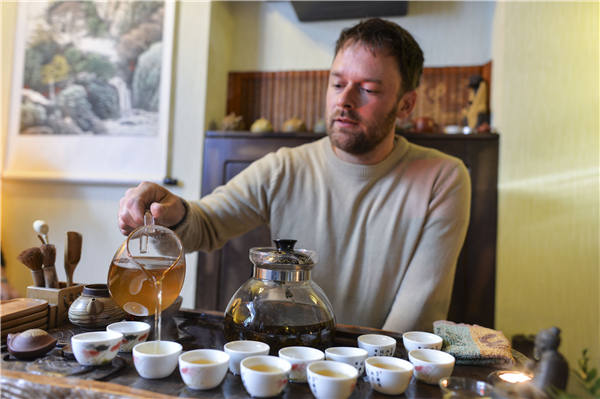
A tea somelier displays Chinese tea making in Tomck, Russia, which shows the influence of the Sino-Russian Tea Road. Hu Dongdong/China Daily |
The Sino-Russian Tea Road, or the "10 thousand li (5,000 kilometers) of tea road" that once saw tea from East China's Fujian province carried all the way to Mongolia and Russia had its heyday almost two hundred years ago.
A group of reporters from Changjiang Daily, a newspaper based in Wuhan, Hubei province, traveled the entire length last year, hoping to rediscover the route that fell to disuse in the early 20th century. The resulting book of journals, Revisiting the Sino-Russian Ten Thousand Li of Tea Road was launched last week in Beijing.
"It's no longer a route devoted to tea business," says Li Wan, one of the writers. "But with upgraded transportation, it's just as lively now as it connects and supports communication and shipping other than tea along the pathway. "
The reporting group had driven through the entire route in two months, visiting more than 20 important posts on the road: Wuyi Mountain in Fujian, the birth place of many of China's renowned teas; Hankou, the go-to hub for tea business during that period; Jincheng, where the Jin merchants of Shanxi province were the biggest force behind tea business to Russia; as well as foreign cities from Ulaanbaatar, the Mongolian capital, to St. Petersburg, where the trip ends in Russia.
Three hundred years ago, when the Tea Road first took shape, it could be a one- or two-year trek on foot or by cart. Shipping development managed to shorten the travel, as Hankou also slowly rose to international fame as the "Oriental tea port". Factories were set up, new ways to deal with finances were invented. Still later, railways that largely traced the original Tea Road came about. The cities are connected by highway these days.
"The Tea Road covers so many Chinese, Mongolian and Russian cities, it shows how cultural influences spread in the past," says another Changjiang Daily writer, Xiao Chang. "The Tea Road shows how industrial, modern changes have taken place and changed the surrounding regions. In a way it's complementary to the Silk Road."
Also called the "Century Artery" between China and Russia from the period, one of the route's most lasting legacies is the spread of Chinese tea culture to other countries.
The Russian czar first tasted Chinese tea in 1638, marking the start of fascination with the Chinese beverage. By the early 19th century, serving Chinese tea had become the best thing a host could do for a guest in Kazan. Tea shops that sold Chinese tea were must-go places in early 20th century Moscow, according to the book. It pieced together the map of Chinese tea's expanding influences with findings from local relics, museums and interviews.
The connections found in tea are still alive and well today.
"It's not just one or two tea shops you see in St. Petersburg today," writer Li says. "Chinese tea and tea sets are sold, tea ceremonies are performed, and of course, a large amount of tea is consumed there. Drinking Chinese tea is all the rage now."
"We are very likely the first group of people to have traced the Tea Road in its entirely," says Zheng Ruke, another of the writers group. "We see now why the route is called the artery between China and Russia."
"Such routes between countries, even continents, may start with a commercial item, but they will grow to incorporate more and become links that deepen understandings of all the people who live on and along the roads."
"The Great Tea Road is a great example of China and Russia's ongoing exchange in economics and culture," says Andrey Ivanovich Denisov, the Russian ambassador to China, who attended the book launch. "It stands witness to the bilateral friendship that still thrives today."
sunye@chinadaily.com.cn
Copyright 1995 - . All rights reserved. The content (including but not limited to text, photo, multimedia information, etc) published in this site belongs to China Daily Information Co (CDIC). Without written authorization from CDIC, such content shall not be republished or used in any form. Note: Browsers with 1024*768 or higher resolution are suggested for this site.
License for publishing multimedia online 0108263 Registration Number: 130349 










 Raymond Zhou:
 Pauline D Loh:
 Hot Pot
 Eco China
 China Dream
 China Face