 |
|
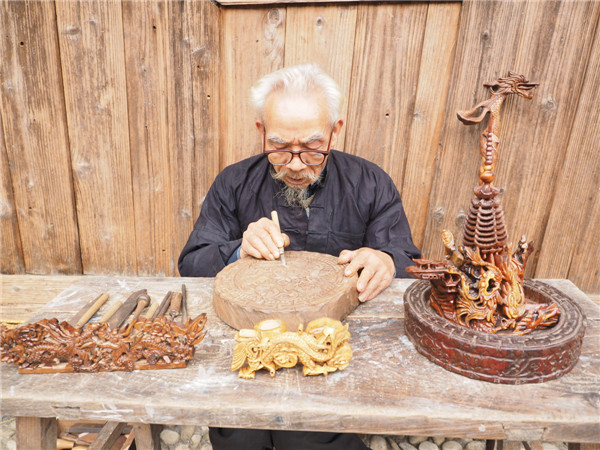
An elderly villager makes a traditional musical instrument of the Dong ethnic group in Dali village. ZHANG JIHUI/CHINA DAILY |
They are on a list compiled by several central government departments, including the Ministry of Housing and Urban-Rural Development, the Ministry of Culture and the State Administration of Cultural Heritage.
Among them, 276 are in Qiandongnan, which is the most for all city-level administrative regions in the country.
A China Traditional Village Summit was held earlier this month in Qiandongnan to explore ways to better preserve the disappearing landscape.
Zhou Jian, an architecture professor from Tongji University, says: "Protection of traditional villages should not focus only on the architecture or landscape.
"Our work should pay more attention to local communities, to encourage their participation."
He says that many projects, like countryside museums, introduced in the villages in Qiandongnan had failed because they are not "down-to-earth" enough.
"Experts and governments cannot make all the decisions for the villagers. We need more consultation with the locals. If villages are not comfortable places to live in, it will be impossible to talk about their protection."
Consequently, for richer villages where people have begun to build brick houses, Zhou suggests preserving some wooden structures and drafting plans mutually acceptable to villagers and designers.
"The protection of traditional villages does not mean that the landscape should remain unchanged. It is not sensible to adopt one model for all villages," says Zhou.
While promoting tourism is seen as a good way to revitalize villages, the lives and traditions of the local people often get disrupted.
Take Biasha village for example. The village is inhabited by the Miao ethnic group (known as the Hmong abroad). The Miao there are known as one of China's last hunting tribes and for their belief in a tree god.
As Gun Shuige, a local tour guide, says: "Before the development of tourism in 1999, everything was unchanged. Except for trading our lumber for salt in a nearby market, we didn't even need to go out of the village.
"But now, every day is festival," he says with slightly embarrassed smile.
Earlier, the lusheng, a traditional musical instrument, was used only for major celebrations or rituals, but the village stages lusheng shows three times a day for tourists.
In Xijiang village, one of the largest Miao villages with 6,000-plus inhabitants, things look even more dramatic since tourism started in 2009.
If you take battery-powered cars to tour the place, it is tough to spot a typical residence house in an ocean of karaoke places, barbecues and pubs.
As for traditions, Xibaoyi, a 23-year-old local guide, says a local "fire-caution" festival has become a casualty of the tourism push.
Copyright 1995 - . All rights reserved. The content (including but not limited to text, photo, multimedia information, etc) published in this site belongs to China Daily Information Co (CDIC). Without written authorization from CDIC, such content shall not be republished or used in any form. Note: Browsers with 1024*768 or higher resolution are suggested for this site.
License for publishing multimedia online 0108263 Registration Number: 130349 














 Raymond Zhou:
 Pauline D Loh:
 Hot Pot
 Eco China
 China Dream
 China Face