 |
|
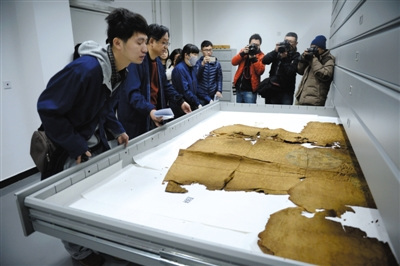
Journalists from Beijing media visit the new storehouse. [Photo/Beijing News] |
In order to remove and settle all these historical relics safely, staff members customized 5,000 special cases. The cases were so secure that they could survive a 30 meter drop.
In addition, every historical relic passed six-step process which included a visual check, a photographing, precise packing, binning, transporting, devanning and classification. The head of the historical-relic transfer project told local journalists that in the past eight months, more than 10,000 photos were taken of all the relics.
Despite the historical relics being officially moved into their new home, the work remains unfinished. Staff members must now put each relic on the shelves in an order. They must also record their shelving locations and record detailed information.
The new storehouse will not be open to public, but some of the selected cultural relics will be exhibited in the future. At present, the golden crown of Wanli Emperor of Ming Dynasty (1368-1644) is on display at the Museum of the Ming Tombs. It's become the key highlight of the museum weighing 826 gram and standing 24 centimeters high.
The Ming Tombs are the cemeteries of 13 Ming Dynasty emperors, 23 empresses, crown prince's, princesses, and many imperial concubines after the Ming Dynasty moved its capital city to Beijing. The unique ensemble of cultural landscapes is evidence to a cultural and architectural tradition that surpassed the Ming Dynasty and had an everlasting impact in China's history. It boasts high historic and cultural values due to its grand architecture, complete system, and long history.
All 13 mausoleums are similar in architectural style and overall arrangement the only differences are in its size and complexity. Ming Tombs, as a unified whole, each represents a separate mausoleum units. Each tomb was built in a Piedmont. Each has a forecourt where memorial ceremonies and sacrifices were held with a tomb mounded at the back. Every tomb is separated by half a kilometer between, up to eight kilometers.
Under the guidance of the theory of traditional Chinese Feng Shui, from site selection to planning and design, the design of the Ming Tombs were focused on the harmony of mausoleums: water, plants, nature. The Ming Tombs, as an outstanding representative of ancient Chinese Mausoleum, show rich connotations of Chinese traditional culture. On July 2003, it was inscribed on the UNESCO's World Heritage List. They were listed along with other tombs under the "Imperial Tombs of the Ming and Qing Dynasties" designation.
Copyright 1995 - . All rights reserved. The content (including but not limited to text, photo, multimedia information, etc) published in this site belongs to China Daily Information Co (CDIC). Without written authorization from CDIC, such content shall not be republished or used in any form. Note: Browsers with 1024*768 or higher resolution are suggested for this site.
License for publishing multimedia online 0108263 Registration Number: 130349 









 Raymond Zhou:
 Pauline D Loh:
 Hot Pot
 Eco China
 China Dream
 China Face