 |
|
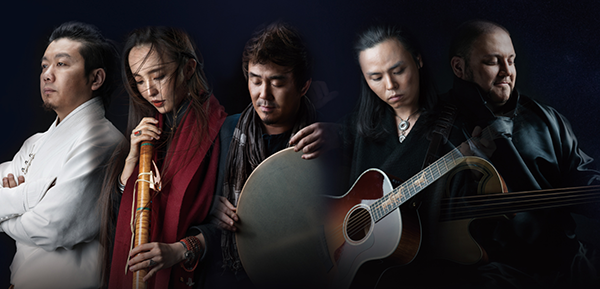
The band Haya, founded by Zhang Quansheng (left), is devoted to taking Mongolian music to a wider audience.[Photo provided to China Daily] |
In a spacious room of a five-star hotel in downtown Beijing, people are walking around, watching the streams of cars on Chang'an Avenue flow beneath a warm afternoon sun, and waiting. Suddenly, the sound of a hand drum erupts and the five members of the band Haya appear in the room.
As Zhang Quansheng pulls the strings of a matouqin, a horse-head fiddle, lead vocalist Daiqing Tana, dressed in a long red gown with her hair braided, slowly steps forward.
Other members, including drummer and khommei (throat-singing) singer Bao Yin, guitarist and matouqin player Chen Xibo and bassist Eric Lattanzio, speed up the music and Tana's voice soars, reminding her audiences of Mongolian women riding horses on the grasslands.
"That's what we have been doing during the past 10 years, translating our traditional Mongolian music to the contemporary era," says Zhang, who founded Haya in Beijing in 2006.
"Our music also expresses our love for the grasslands and nomadic people."
Haya is launching a national tour in Beijing on Dec 24.
"I hope our music will appeal to not just Mongolians, but also people of other ethnic groups," he says.
During the past 10 years, the band has released five studio albums, including songs adapted from traditional Mongolian folk songs and their original compositions. Almost all songs are sung in the Mongolian language.
The band has won the established Golden Melody Awards of Taiwan three times: with its first album Wolf Totem in 2009; its CD Migration in 2012; and its album Crazy Horse last year.
Haya has also performed throughout the country and abroad-in Sweden, Germany and Canada.
In the Mongolian language, haya means "the edge", which is a metaphor for a nomadic lifestyle that has become so edgy today.
"In our home, people used to live in harmony with nature. But this has been compromised by the industrialization of society," Zhang says.
"Our traditional songs and instruments have also become edgy. When I started the band, I hoped to bring them back," he adds.
Zhang grew up with his grandparents and moved to Hohhot, the capital of the Inner Mongolia autonomous region, with his parents at age 8, when he started to learn the violin and matouqin.
The versatile singer-songwriter graduated from the music department of Minzu University of China in Beijing in 1991, and is now regarded as one of the best matouqin players in the country.
Copyright 1995 - . All rights reserved. The content (including but not limited to text, photo, multimedia information, etc) published in this site belongs to China Daily Information Co (CDIC). Without written authorization from CDIC, such content shall not be republished or used in any form. Note: Browsers with 1024*768 or higher resolution are suggested for this site.
License for publishing multimedia online 0108263 Registration Number: 130349 










 Raymond Zhou:
 Pauline D Loh:
 Hot Pot
 Eco China
 China Dream
 China Face