 |
|
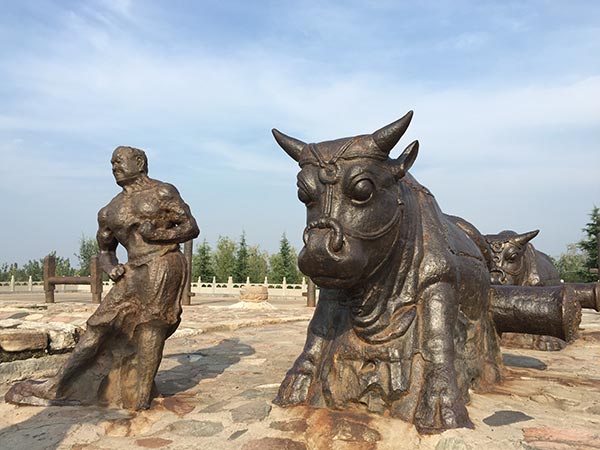
Iron oxen and iron men built during the Tang Dynasty (AD 618-907) stand where the Yellow River once flowed. They were used to rivet the pontoon bridge of an ancient ferry. [Photo by Xu Lin/China Daily] |
Shanxi province nurtures an ancient civilization in the mid-section of the Yellow River, with picturesque natural scenery and cultural relics that showcase its important role in Chinese history.
China's second largest waterfall, the Hukou, is located in the border of Shanxi and Shaanxi provinces, about 45 kilometers from Jixian county, Linfen city.
Hukou, which literally means the spout of a teapot, vividly describes the magnificent scene when the 400-meter-wide Yellow River is blocked by mountains and suddenly pours through a deep groove of 30 to 50 meters' width.
Some old farmers who live nearby dress up their donkeys with colorful cloth and a large red flower on the animals' heads, offering rides to tourists for a small fee.
In winter, the waterfall turns into a frozen world of ice pillars and columns-a different kind of natural beauty.
Beyond the scenery, the Yellow River is the cradle of ancient Chinese civilization. Located in the northeast of Xiangfen county, Linfen city, the Taosi ruins span an area of about 2.8 million square meters and a history of 4,100 to 4,300 years.
Archaeologists have researched the site since 1978 and announced their discoveries this June.
They believe that Taosi was the capital of the sage emperor Yao, who lived in the middle reaches of the Yellow River at that time. It is recorded that Yao built his capital at Pingyang, the ancient name for Linfen, but there was no archaeological proof before.
The new studies indicate the existence of a civilized and hierarchical society, with fortifications such as walls and moats, funerary objects of wood furniture and kitchenware, and function areas including a royal palace, living area for nobles and mausoleums.
In 1984, the earliest Chinese characters were found on a pottery in the ruins. Experts identified one character as wen (literary), and argued the others looked like yao (the emperor Yao), yi (change) and ming (life).
Copyright 1995 - . All rights reserved. The content (including but not limited to text, photo, multimedia information, etc) published in this site belongs to China Daily Information Co (CDIC). Without written authorization from CDIC, such content shall not be republished or used in any form. Note: Browsers with 1024*768 or higher resolution are suggested for this site.
License for publishing multimedia online 0108263 Registration Number: 130349 






 Raymond Zhou:
 Pauline D Loh:
 Hot Pot
 Eco China
 China Dream
 China Face