 |
|
Photo provided to China Daily |
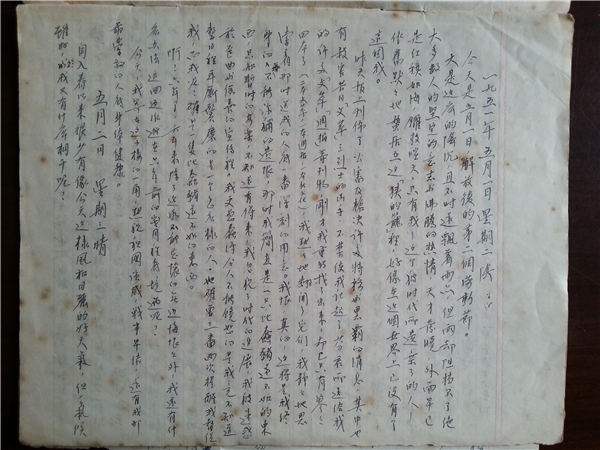
"The diaries can be seen as detailed portrayals of common people's life during those years in Shanghai. Anyone who wants to study the politics, economy, culture, art, folk customs, even history of pricing or weather (of the city) has to read this book," Wang Jincai says.
Yan, the diaries' writer, was born in Ningbo in East China's Zhejiang province, and lost his mother at an early age. His father remarried and Yan was raised by his grandmother. He finished six years of elementary education in his hometown before moving to Shanghai along with his sister after their father died in 1937.
After finishing middle school, he went to a local hardware store to be an apprentice. When he started writing his first diary on Jan 1, 1942, he was 19 years old.
The diaries show that even before Yan's father died, the family had become poor. Their houses and land had been mortgaged. The rough early years cultivated Yan to be an aspirational young man. He was diligent, made a lot of friends and spoke out against injustice.
Yan also suffered from an Oedipus complex, according to Wang Jincai. His mother had died when he was young.
Yan also spoke about his many relationships with young women.
As a young man in the middle of an ongoing war, Yan also described the hard life back then: how prices of goods rose quickly, how homeless people suffered starvation. Many times, he expressed the shame that he could not fight and die in the frontline like some of his friends did. But he was happy to earn a living.
On one hand, Yan wrote he despised graft within the Kuomintang system and on the other, the despotism and incompetence of the times made him suspicious of the communists, according to Wang. As a result, instead of joining the revolution like some of his classmates, he started a business after 1946, and indulged in drinking and playing mahjong.
Although the book ends in 1945, Yan's diaries went on for years after. Wang has attached fragments of Yan's writings from 1946-64 in the appendix of the book.
"After 1946, Yan kept the diaries only on and off. Because the occupation had ended, I just cited some important parts to tell readers the changes of his fate, getting married and having children, in case they worried (what happened to him)," Wang says.
Wang tried to contact the writer of the diaries, but there is no clue whether Yan is still alive or not.
yangyangs@chinadaily.com.cn
Copyright 1995 - . All rights reserved. The content (including but not limited to text, photo, multimedia information, etc) published in this site belongs to China Daily Information Co (CDIC). Without written authorization from CDIC, such content shall not be republished or used in any form. Note: Browsers with 1024*768 or higher resolution are suggested for this site.
License for publishing multimedia online 0108263 Registration Number: 130349 






 Raymond Zhou:
 Pauline D Loh:
 Hot Pot
 Eco China
 China Dream
 China Face