 |
|
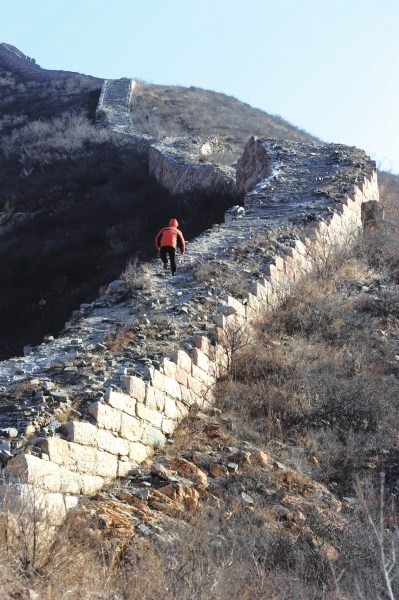
A tourist hikes on the wild Great Wall in Hebei province. [File photo] |
Though the Chinese government promulgated the "Great Wall of Protection Ordinance" in 2006, the world famous ancient stone fortification is still disappearing at a tremendous speed, especially the parts in forsaken mountain areas.
According to research by the China Great Wall Society, it is not optimistic about the protection of the Great Wall. For example, only 8.2 percent of the Great Wall built in the Ming dynasty (1368-1644) is in good condition presently.
Moreover, in the report released by the Chinese State Administration of Cultural Heritage in 2012, less than 10 percent of the Ming Great Wall is preserved adequately, 20 percent is moderately preserved, and almost 30 percent has disappeared.
The World Monument Fund based in New York announced in 2003 that the Great Wall was among the 100 most endangered historic sites.
Bad weather is one of the main causes of damage to the Great Wall. Dong Yaohui, the deputy of the China Great Wall Society, said that most parts of the masonry structure of the Great Wall are in Beijing and Hebei province. Though they are more stable than the sun-dried mud brick Great Wall, in the rainy seasons during July and August, they can be easily broken by storms.
Local data shows that in the summer of 2012, 36 meters of the Dajing Gate part of the Great Wall in Zhangjiakou, a city in northwestern Hebei province, was damaged by storms; the Shanhai Pass part in Qinhuangdao, a city in northeast part of Hebei province, leaked badly; while some fighting towers of the Wulonggou portionin Laiyuan, a city in western Hebei province, totally collapsed.
Even in the dry seasons, because of lack of protection, the Great Wall in the mountain areas in Hebei province was eroded by mountain springs or even plants. In Funing County, a county in Qinhuangdao, if you slightly touch the wall of the watchtowers, you will find soil peeling off. There are also trees growing in the cracks of the Great Wall.
People living around or travelling to the Great Wall which has not been developed into tourist attractions are also damaging the wall. According to Zhang Heshan, a Great Wall protector in Funing County, more travelers have been exploring the wild Great Wall in recent years. The frequent trampling has led to damage, causing the bricks to loosen, and even walls to collapse. However, there were not enough protectors to patrol around these areas, and not enough money to restore the damage.
Journalists from the Beijing Times also found that people in some villages of Lulong County, in the west part of Qinhuangdao, lived in the houses built with ancient blue and grey bricks. They told the journalists that these bricks were removed from the Great Wall nearby.
Some villagers even sold the Great Wall bricks with carved characters. An unnamed villager in Dongfeng Village told the Beijing Times journalist that the market price of these bricks is 40 to 50 yuan ($6.4 to $8.05) a piece, or even as low as 30 yuan ($4.83). The villagers collect such bricks from the Great Wall without a second thought.
Copyright 1995 - . All rights reserved. The content (including but not limited to text, photo, multimedia information, etc) published in this site belongs to China Daily Information Co (CDIC). Without written authorization from CDIC, such content shall not be republished or used in any form. Note: Browsers with 1024*768 or higher resolution are suggested for this site.
License for publishing multimedia online 0108263 Registration Number: 130349 











 Raymond Zhou:
 Pauline D Loh:
 Hot Pot
 Eco China
 China Dream
 China Face