 |
|
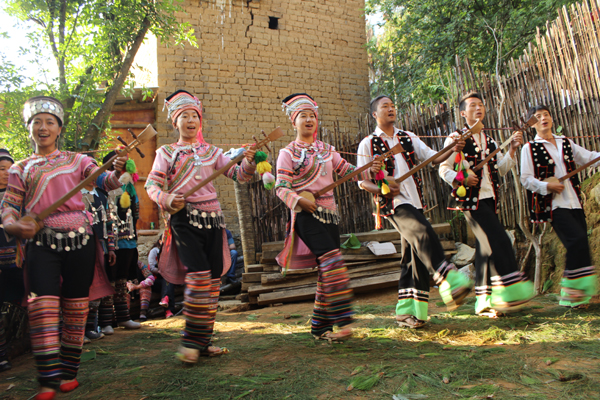
Members of the Hani ethnic group in Puchun village in Yunnan province's Honghe county, Honghe Hani and Yi autonomous prefecture, sing their polyphonic folk songs, which are listed as national intangible cultural heritage. Wang Kaihao / China Daily |
"You cannot find many people from my generation singing songs at home. They all leave the village to look for jobs," Chen says.
She had left the village three times, but her father always persuaded her to return. The county's cultural bureau eventually offered her a musician's job.
"She sings well, and deserves to stay here," says Chen Xiniang, Chen's father, who is also a national-level inheritor of Hani polyphonic folk music. The genre was registered as a national intangible cultural heritage in 2008. "But most people singing today are older than 40. In the old days, if you couldn't sing, you cannot do anything. You would never find a girlfriend."
Unlike folk songs of other ethnic groups in southwestern China, which are usually upbeat, the songs of the Hani people have a more somber mood.
"No one can say why it is so, but you will probably understand part of the reason when reviewing Hani history," says Wu Zhiming, from Honghe county's cultural promotion office, who has collected Hani folk songs since the 1980s.
The Hani ethnic group is believed to have originally migrated from the Qinghai-Tibetan Plateau after continuous conflicts with other tribes. They eventually settled in the mountainous area of southern Yunnan.
Copyright 1995 - . All rights reserved. The content (including but not limited to text, photo, multimedia information, etc) published in this site belongs to China Daily Information Co (CDIC). Without written authorization from CDIC, such content shall not be republished or used in any form. Note: Browsers with 1024*768 or higher resolution are suggested for this site.
License for publishing multimedia online 0108263 Registration Number: 130349 












 Raymond Zhou:
 Pauline D Loh:
 Hot Pot
 Eco China
 China Dream
 China Face