|
 |
|
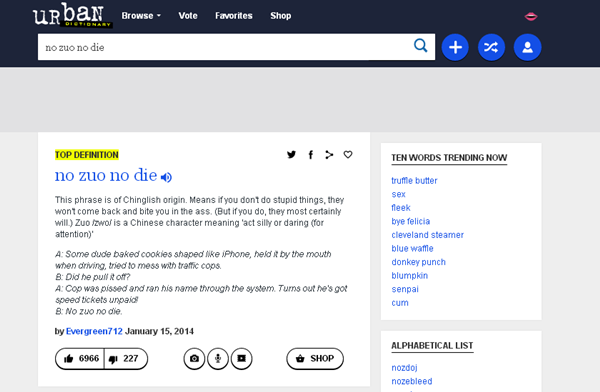
A screen shot of the Urban Dictionary's explanation of Chinese borrowed word "no zuo no die".[Photo/chinadaily.com.cn] |
An official report released on?Wednesday shows that the number of Chinese words in English dictionary has rocketed in the past 20 years and the internationalization of Chinese language has become a new cultural trend.
According to the Cultural Construction Blue Paper- China's Culture Development Report (2014), published by Hubei University and Social Sciences Academic Press (China), the use of Chinese words in foreign languages is growing at a fast rate.
Chinese Internet buzzwords, such as "no zuo no die" (which translates into English as "if you don't do stupid things, they won't come back and bite you in the back"), "you can you up, no can no BB" (which rougly translates into English as "if you can do it you should go up and do it, instead of criticizing others' work") have already been incorporated into the American Urban Dictionary, creating a big splash on the Internet last year.
Other words like "Tuhao" (meaning rich rednecks) and "Dama" (referring to elderly women) are likely to be included in the Oxford Dictionary in the coming days, drawing global attention.
The report?said that the increasing use of Chinese is a sign of the country's national power and International status.
Base on initial statistics, there are more than 3,000 colleges and universities in over 100 countries that teach Chinese language.
In Korea, around 100 institutions offer Chinese courses and over 1,000,000 students are learning it; while in Japan, the number of people learning Chinese has reached 2,000,000. In the US alone, up to 3,000 high schools are offering Chinese courses.
Marie Tulloch, 24, a postgraduate student of Foreign Trade University from the UK, said it it's possible that Mandarin words would be used in English in everyday life in the future.
"English already has some Cantonese words. Like the pan we use for cooking, we call it 'wok', which comes from Cantonese," she said, "maybe it is just a matter of time before we use Mandarin."
Judith Huang, 29, from Singapore, said that borrowing words from other languages is a way to keep culture alive.
"Language is alive so there will naturally be borrowing from one language to another especially as more people become bilingual," She said.
Meanwhile, the document also said that the "Chinese fever" is not as hot as previously reported. The total number of those learning Chinese as a second language is still below 150 million worldwide, lagging behind popular choices such as French, Spanish and Japanese.
The blue paper added that those borrowed Chinese words, with their corresponding social and cultural background, would help the western world get a deeper understanding of China. However, it is still too early to see their impact on the mainstream English language.
Related:
Copyright 1995 - . All rights reserved. The content (including but not limited to text, photo, multimedia information, etc) published in this site belongs to China Daily Information Co (CDIC). Without written authorization from CDIC, such content shall not be republished or used in any form. Note: Browsers with 1024*768 or higher resolution are suggested for this site.
License for publishing multimedia online 0108263 Registration Number: 130349 













 Raymond Zhou:
 Pauline D Loh:
 Hot Pot
 Eco China
 China Dream
 China Face