|
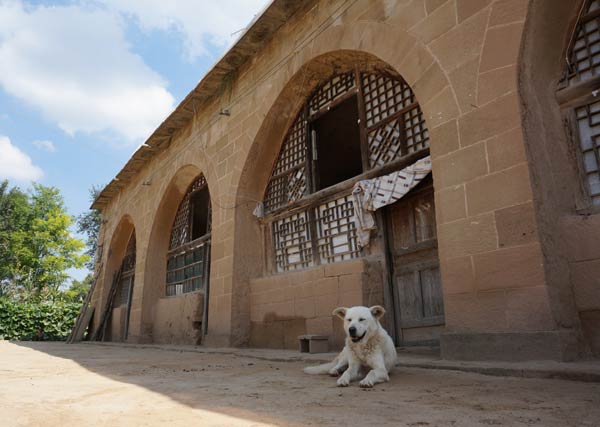
Weita village in Yan'an, Shaanxi province. [Photo Provided to China Daily] |
Disappearing villages
Villages have been disappearing at an alarming rate, with nearly 300 - many of them ancient - dying every day from 2000-2010, according to Feng Jicai, vice-chairman of the China Federation of Literary and Art Circles and an advocate of the protection of ancient villages.
"The rapid urbanization and the fast building of the 'new socialist countryside' are the main reasons behind the extinction of ancient villages. Development is necessary, but rural culture is being discarded, largely because we didn't have enough time to prepare for the changes," Feng told the Web portal Sohu in an interview.
"There are now an alarming number of empty or even dead villages, because the young people have left to work in cities and towns, leaving the elderly in the countryside, or sometimes even taking them to live in cities and towns, too."
Modocom's Chen Yu shared Feng's opinion, saying that sooner or later villages close to large cities, such as Lulei, will be cleared to make way for urban expansion.
However, although he acknowledged the changes as "unchangeable fate", Chen called for a measured and sensitive approach. "The demolition shouldn't be oversimplified and crude. The government can give the village a 'health check' beforehand to find out if there are any important historic relics," he said.
"We are unable to preserve the whole of Lulei village, but we can preserve its three most important buildings - the ancestral hall, and the homes of Chen Jingrun and Chen Shaokuan," he added. "If these three old buildings were well protected near the modern railway station, Fuzhou natives would be able to show them to foreign visitors and proudly say, 'We have developed, but at the same time we have respected our history'."
In December 2013, the Ministry of Housing and Urban-Rural Development started the first national census of traditional buildings in an attempt to protect the nation's non-renewable cultural heritage. The nine-month survey identified as many as 15,000 traditional dwellings in 31 provinces, autonomous regions and municipalities.
"Traditional Chinese culture is maintained in traditional dwellings. However, few farmers we met during the journey realized the beauty and value of their old houses," said Sun Jinlong, 57, an artist who traveled as a member of Chen Yu's team.
In Yanwo, Sun was pained to visit a Hui-style house and discover exquisite wooden beams bearing carvings explaining the basis of Confucian morality had been poorly maintained. Moreover, a number of similar carvings had been stolen, probably by antique dealers, even though the owner was puzzled as to why the thieves wanted "the pieces of wood".
"It's the government's duty to make farmers aware of the beauty and value of their traditional dwellings. It's an urgent task," Sun said.
Copyright 1995 - . All rights reserved. The content (including but not limited to text, photo, multimedia information, etc) published in this site belongs to China Daily Information Co (CDIC). Without written authorization from CDIC, such content shall not be republished or used in any form. Note: Browsers with 1024*768 or higher resolution are suggested for this site.
License for publishing multimedia online 0108263 Registration Number: 130349 













 Raymond Zhou:
 Pauline D Loh:
 Hot Pot
 Eco China
 China Dream
 China Face