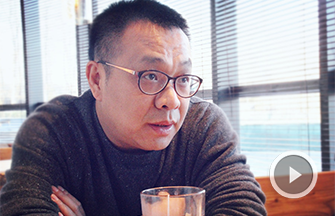
Leopold Leeb, 48, is a professor at Renmin University of China. He has spent more than a decade teaching Latin, Greek and classical Hebrew in Beijing. He tells China Daily he believes that classical languages can bridge cultural gaps between the East and the West.

Leopold Leeb
I was born in the small village of Schoengrabern near Holladbrunn city in lower Austria, and studied philosophy and theology in college. I got interested in Eastern philosophy and considered going to China, Japan or India to learn more about ancient wisdom.
Then one of my teachers told me: "Go to China, because the Japanese philosophy was developed later, and the root of Eastern philosophy lies in China." In 1988, our university had a scholarship for studies at the Fu Jen Catholic University in Taiwan, so I went and started to learn Mandarin there.
At first it was just the mysterious Eastern culture that attracted me, but after I read on Confucianism and Taoism, I was amazed by Chinese philosophy. After some time, my interest diverted to the encounters and exchanges between Chinese and Western thoughts.
When I returned to Austria in 1991, I stopped in Beijing for about two weeks. At the time, there were fewer vehicles and overpasses in the city, and willows dotted the sides of most roads. It was an ideal setting for a bicycle lover like myself. I fell in love with Beijing at once and decided to come back soon.
Three years later, I was recommended by a friend to study with renowned philosopher Tang Yijie at Peking University as a doctoral student, focusing on the introduction and the spread of Christianity in China.
After graduating in 1999, I started teaching Latin and Greek at the Chinese Academy of Social Sciences, the think tank, and since 2004 at the Renmin University of China.
Back then, there were fewer than 20 students taking my course, and publishers wouldn't publish my textbook. They said: "Sorry, you can just photocopy your manuscripts, we don't publish Latin textbooks."
Now, I have around 200 students every semester, and my textbook on Latin and Greek finally got printed last year.
Learning these languages enables us to communicate with ancient wise men. When I first read The Analects of Confucius in Chinese by looking up the dictionary word by word, I felt like I was talking to them an who lived some 2,500 years ago, and it gave me tremendous joy.
Likewise, when my students and I read The Iliad or The Republic, we "talk" to Homer and Plato, seeing the world the way they described it and thinking about the questions they asked.
I usually cite a line from the book of Corinthians in the Bible, "The letter kills, but the spirit makes alive" to emphasize that learning a language isn't an end by itself. What's important is to read the original texts and learn about what they are actually trying to convey. The Western classical languages are difficult to learn, but being able to absorb the spirit behind the texts makes it all worthwhile.
Nowadays, Chinese are crazy about learning English, but many don't know that English has been influenced by Latin in many ways, and if one wants to understand Western culture, one has to learn Latin. So I always wonder why the Chinese are content with superficial understanding instead of seeking the roots of the language.
In modern Chinese, there are also many words that come from the West. For example, the word for "capital city" in traditional Chinese is jing cheng, instead of what is today commonly used-shou du. The latter literally means "the head city" and is actually translated from the Latin prefix "cap it", meaning head.
I used to have a dream of building a language school dedicated to Western classical languages, which now still seems unrealistic, but I have opened up courses in Renmin University and Beijing Normal University, and on weekends I do public teaching at the Xishiku cathedral and PostWave publishing company, so my dream is being partially realized.
Besides teaching, I use my spare time writing books on classics studies and I have published more than 30 titles so far. I see my students as my children, and want to give them my best.
Copyright 1995 - . All rights reserved. The content (including but not limited to text, photo, multimedia information, etc) published in this site belongs to China Daily Information Co (CDIC). Without written authorization from CDIC, such content shall not be republished or used in any form. Note: Browsers with 1024*768 or higher resolution are suggested for this site.
License for publishing multimedia online 0108263 Registration Number: 130349 










 Raymond Zhou:
 Pauline D Loh:
 Hot Pot
 Eco China
 China Dream
 China Face