Fear is personal, but horror movies reflect society's shared fears and are rooted in culture heritage and anxiety, according to experts.
Among the non-human creatures that kill people mercilessly in horror movies, vampires must are some of the oldest and most common characters.
The 1896 French movie Le Manoir du Diable directed by Georges Melies - released in the US as The Haunted Castle and in the UK as The Devil's Castle - is both the world's first horror and vampire movie.
The concept of vampires originated in memories of the Black Death in medieval Europe, when millions died, according to Chen Juan, a movie researcher and teacher at Jiangsu Normal University, who says the symptoms of the disease, such as pale faces or coarsened voices, lodged deep in the memories of the survivors, inspired vampire folk tales, which were eventually written down and evolved into literature.
Later, vampires arrived on the stages, and then transferred to film when movies arrived on the scene.
Other horror staples, such as werewolves and mummies, also have their origins in history, and like vampires, they have changed and evolved along with human society.
Before the 1970s, movie vampires were usually depicted as wicked old men, even the youngest looked middle-aged, but they have morphed to meet the needs of a new generation, with both sexes becoming younger, better looking, energetic and sexy.
In his book, Dating Without Watching Horror Movies Is Not Cool, Taiwan horror movie fan Tan Tang-mo writes about how modern issues, such as environmental pollution, drug abuse, loneliness and double-edged technological development, have inspired moviemakers because horror movies are a reflection of reality.
Jiangsu Normal University's Chen has studied the differences between zombies in Hong Kong and Western movies.
The 1990s witnessed a series of classic Hong Kong-made zombie movies, starring actor Ching-ling Lam, but the Chinese undead are very different from their Western counterparts.
For example, Chinese zombies - called jiang shi, literally "stiff corpses" - hop to move, while Hollywood zombies simply stagger. Unlike Western zombies, they don't eat flesh, or bite people to drink their blood. Instead, they drink qi, or "life energy".
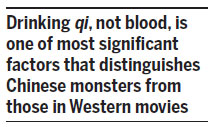
According to Chen, drinking qi, not blood, is one of most significant factors that distinguishes Chinese monsters from those in Western movies - a trait that's exemplified by another stereotypically evil character in Chinese horror movies, huli jing, or the fox spirit, who seduces men to feast on their qi and maintain her beautiful and youthful appearance.
The differences may well reflect the disparity between Chinese and Western notions of life - Chinese people attach great attention to jing qi shen, or the well being of spirit and mind, while Western people care more about the forms and existence of the body, Chen says.
In Chinese literature, classics such as Strange Stories from Liaozhai and The Classic of Mountains and Seas, are full of tales about the spirits of foxes and other animals and plants that adopt human form to do good or evil to ordinary people, according to Chen, who says it's a shame modern Chinese moviemakers fail to make good use of them.
Copyright 1995 - . All rights reserved. The content (including but not limited to text, photo, multimedia information, etc) published in this site belongs to China Daily Information Co (CDIC). Without written authorization from CDIC, such content shall not be republished or used in any form. Note: Browsers with 1024*768 or higher resolution are suggested for this site.
License for publishing multimedia online 0108263 Registration Number: 20100000002731 




 Raymond Zhou:
 Pauline D Loh:
 Hot Pot
 Eco China
 China Dream
 China Face