 |
|
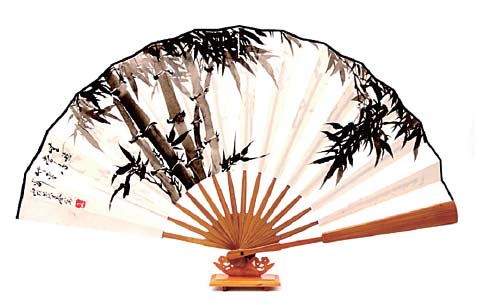
Ornate folding fans bear eye-catching designs. Photo provided to Shanghai Star |
As raw materials such as sandalwood become more precious and harder to obtain, these fans are now mostly bought by collectors. Carving and putting together a sandalwood fan with traditional Chinese motifs is a timeconsuming and costly process. A senior craftsman spends at least a couple of months to perfect one single fan. "The best craftsmen are getting older, and younger workers cannot fill their shoes. That's why we price sandalwood fans at up to 10,000 yuan," Li says.
Paintings by famous artists are one of Li Yun Ge's most distinctive offerings, and paintings mounted on the fans may cost anything from several hundred to 30,000 yuan, depending on the reputation of the artist. Customers can also order a specially made fan and determine what painting they want mounted on the fan – be it landscape, birds and flowers, figure painting, or calligraphy. And in May this year, Li Yun Ge fans became available in Yangzhou in Jiangsu province, for the first time in its history, expanding beyond its native Shanghai.
|
|
|
|
Long evolution
In the old days, when there were no air-conditioners, a handheld fan was the only way to cool down. According to Chinese folk tales, the fan's history can be traced back to Emperor Shun, who lived before 2000 BC. It's said Shun made the Wuming fan as a symbol of "collecting opinions, and looking for talents to better serve the country".
Historical records show that China's first fan was made of pheasant feathers, and that is why the Chinese character "shan", or fan, contains the radical for feathers. Fans were mostly made for a similar purpose in subsequent dynasties until the Wei dynasty (AD 220-265), when fans suddenly became an item solely reserved for the use of the emperor.
The folding fans were popularized in the Song dynasty (960-1279), and during the Ming dynasty (1368-1644) and Qing dynasty (1644-1911) writing poems and paintings on fans become a trend in Suzhou of Jiangsu province, and Zhejiang and Sichuan provinces. Feather fans were made up of peacock, goose, crane, and eagle plumage, and were widely used to cool, as decoration, and a prop for dancing and exhibitions in the ancient palace.
Silk fans shaped like a full moon or a hexagon, and framed with bamboo or wire were also in demand. The handle was usually made of a species of rare bamboo or even ivory, and the wafer-thin fan was painted or embroidered with colorful flowers or birds, landscapes or court ladies. Palm-leaf fans, often more than 30-cm long, were more for the masses across China. The palm leaves were dried under the hot sun for about 20 days, and then washed, dried, flattened, and trimmed into various shapes before being framed.
Copyright 1995 - . All rights reserved. The content (including but not limited to text, photo, multimedia information, etc) published in this site belongs to China Daily Information Co (CDIC). Without written authorization from CDIC, such content shall not be republished or used in any form. Note: Browsers with 1024*768 or higher resolution are suggested for this site.
License for publishing multimedia online 0108263 Registration Number: 20100000002731 











 Raymond Zhou:
 Pauline D Loh:
 Hot Pot
 Eco China
 China Dream
 China Face