 |
|
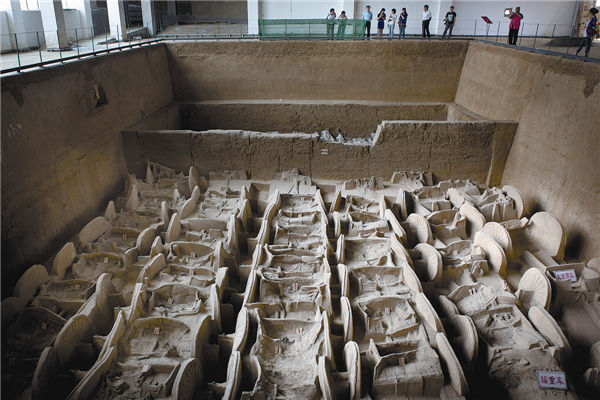
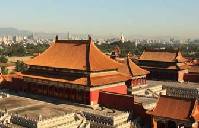
A museum in Linfen, Shanxi province, will open to the public on June 14 and details the history of the Jin Kingdom during the Spring and Autumn Period (770-476 BC). Kuang Linhua /China Daily |
A museum for historical relics in Shanxi province will open its doors to the public on Chinese Cultural Heritage Day, which falls on June 14. The museum honors ancient China's Jin Kingdom and will be located in Qu'wo county in Linfen.
It is also the first museum in Shanxi to unveil the history of the Jin Kingdom during the Spring and Autumn Period (770-476 BC).
The Jin Kingdom dates back roughly 3,000 years ago, but questions remain about the kingdom's emergence. It was not until the late 20th century, when Qucun village relics were discovered, that the place was called the birthplace of the Jin Kingdom. Construction of the museum, which is located on the site where the relics were found, began in August 2009. It covers an area of 14.66 hectares, is supported by an investment of 198 million yuan($31.8 million)and is divided into three exhibition halls that feature the history of the Jin State, a chronology of the unearthing of the relics and details about how the relics are protected.
|
|
|
|
Archeologists began exploring the area in the 1950s when relics and graves related to the Jin Kingdom were discovered. Copper relics, burial accessories and sacrificial pits were discovered from the 1950s to the 1980s.
The museum is surrounded by farmland and provincial roads. Sun Yonghe, head of the museum and the former head of the county's culture relics and tourism bureau, said in the 1980s, as more people learned about the site where the relics were discovered, more and more raiders, most of them nearby farmers, began pilfering from the site. In 1992, grave robbers ignited bombs at the site in an attempt to uncover the treasures.
"Most of the rescue efforts for the site were started after the raiders bombed the site," said Ji Kunzhang, a researcher from the Shanxi Archaeology Institute.
Upon entering the museum are statues of chariots and horses, each 8 meters high. A statue of a monarch of the Jin State is situated in the middle, with four statues of horses in carriages surrounding it.
Visitors will also see more than 1,000 relics from the Jin Kingdom. More than 500 people participated in the excavations of relics over half of a century, with more than 20 excavations carried out during that period.
In the center hall are nine preserved graves of nine Jin emperors. Eight of them were buried with their wives as a funerary object. The relic hall of the museum includes the largest chariot pit in Western Zhou Dynasty (c.11th century-771BC), built 600 years ahead of the Terracotta Warriors.
"Chariot pits discovered here in Qu'wo county include all types of chariots from the Western Zhou Dynasty," said Ji , who participated in excavations during the 1970s. "It also included chariots that are designed for women and children, and it's surprisingly well preserved."
Sun Ruisheng contributed to this story.
Copyright 1995 - . All rights reserved. The content (including but not limited to text, photo, multimedia information, etc) published in this site belongs to China Daily Information Co (CDIC). Without written authorization from CDIC, such content shall not be republished or used in any form. Note: Browsers with 1024*768 or higher resolution are suggested for this site.
License for publishing multimedia online 0108263 Registration Number: 20100000002731 













 Raymond Zhou:
 Pauline D Loh:
 Hot Pot
 Eco China
 China Dream
 China Face