 |
|
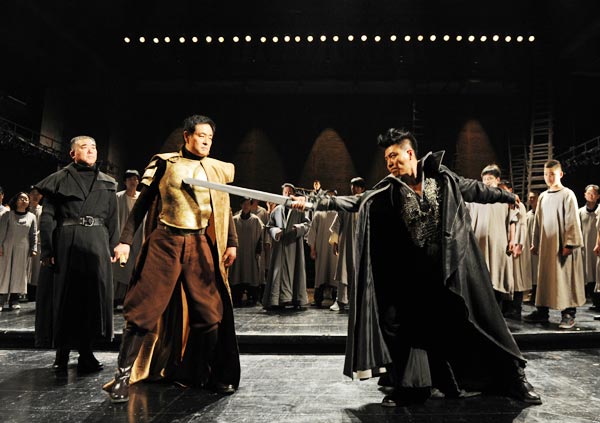
Lin Zhaohua's production of Coriolanus has been wowing critics and audience members since 2007. Pu Cunxin (left), China's prince of theater, plays the title role in this and all other Lin productions. Provided to China Daily |
Different realities
 |
| The language instinct |
 |
| How I discovered the lure of Will power |
 |
| The Bard in Beijing and beyond |
The Chinese reincarnations are often cited as testimony of the Bard's penetration into a different culture. But the reality may be different. Very often, adapting Shakespeare (and other Western sources) is a means of attracting a younger audience. The Taiwan-based actor Hsing-kuo Wu was blunt when he transformed Macbeth into The Kingdom of Desire, a Peking Opera: "By using a foreign play, the company would have a somewhat-neutral text on which it could write its own prescription for the future."
The implicit problem with this approach is over-simplification of the characters. Because Chinese operas are essentially morality dramas with black-and-white portrayals, the adaptors have to sacrifice Shakespeare's richness in portrayal and opt for a cut-and-dried interpretation. When a Shanghai-based opera troupe was commissioned to re-imagine a production of Hamlet in 2005, for the Danish castle where the original story is set, everything had to be trimmed from the original text, and only the element of revenge was preserved. "Hamlet is very complicated, and mine is like an elementary student's version," admitted Feng Gang, the playwright who adapted the story.
Not only are the stories transplanted to China and the names Sinicized, but sometimes even the ending is changed as a mark of respect for the conventions of the particular theatrical form taking on the Bard. A 1994 Yueju opera version of Hamlet dispensed with the tragedy and had the Danish prince rescue his country from his corrupt uncle. Yueju appeals mostly to housewives, so a stage littered with dead bodies was simply out of the question.
In the past two decades an experimental approach has been used - a hybrid of the "authentic" style and total localization. It's interesting to note that all such efforts are in the realm of theater, not opera. Tian Qinxin's new Romeo and Juliet, playing in various Chinese cities throughout 2014, retains key passages from the original text, but all the transitional scenes have been rewritten in the Beijing dialect. One moment Romeo is swearing like a kid from the hutong, or alley, the next he blurts out lines that only those in a sublime state could utter. This juxtaposition may puzzle some members of the audience, but if you treat the original texts as singing it begins to make sense. The setting seems to be a dreamscape that incorporates both Beijing and Verona.
Tian also transposed King Lear to the Ming Dynasty (1368-1644) because "the story fits any time, any place, as long as you capture its essence," according to Li Dong, the producer. Instead of a Shakespearean scholar, the writer of a popular historical novel set during the dynasty was hired to write the adaptation inspired by King Lear.
Copyright 1995 - . All rights reserved. The content (including but not limited to text, photo, multimedia information, etc) published in this site belongs to China Daily Information Co (CDIC). Without written authorization from CDIC, such content shall not be republished or used in any form. Note: Browsers with 1024*768 or higher resolution are suggested for this site.
License for publishing multimedia online 0108263 Registration Number: 20100000002731 









 Raymond Zhou:
 Pauline D Loh:
 Hot Pot
 Eco China
 China Dream
 China Face