 |
|
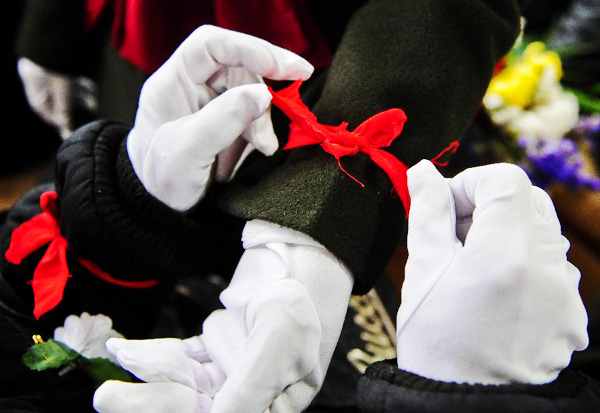
Citizens wear red ribbons as attending a sea burial in Tianjin. [Photo/Xinhua] |
|
|
|
|
Tradition and customs
It was not until the Qing Dynasty (1644-1911) about 300 years ago that the practice of Hanshi or eating cold food was replaced by the Qingming Festival (the Tomb-sweeping Day), which had now become an important occasion for people to offer sacrifices to their ancestors.
In ancient China, Qingming was by no means the only time when sacrifices were made to ancestors. In fact such ceremonies were held very frequently, about once every two weeks, in addition to other important holidaysand festivals. The formalities of these ceremonies were in general very elaborate and expensive in terms of time and money.
In an effort to reduce this expense, Emperor Xuanzong of the Tang Dynasty (618-907) declared in 732 AD that respects would be fomally paid at the tombs of ancestors only on the day of Qingming.This is the custom that continues to date. People will visit their ancestors' graves. They will tidy up, remove weeds and sweep away leaves. This is why Qingming is also known as the Tomb Sweeping Day. Beijing's subway is particularly crowded around the Qingming Festival as people flock to Babaoshan, Beijing's most famous cemetery and crematorium, to pay respects to their departed loved ones.
Qingming is not just a day of remembrance, it is also a day to celebrate the coming of spring, often by going out for a picnic. With the coming of spring, nature wakes up, dressing the world in green. All is new, clean and fresh.
The welcome transition from winter to spring represented by Qingming was an inspiration for many Tang Dynasty poems. The following one by Han Hong is an example.
All over the capital catkins flew wantonly,A scene of the spring so significant,On Cold Foodthe east wind willfjlly,Made the imperial willows slant;Now as the dusk approached quietly,Within the Han palace candles glowed,Towards the five mansions of nobility,The silvery smoke of the tapers flowed.
Qing ming has also been a favorite subject for painting. Zhang Zeduan of the Northern Song Dynasty (960-1127) produced one of China's most famous works of art :“Qingming Shanghetu or Life Along the River at Qingming estival”. This silk scroll is now exhibited at the Imperial Palace Museum, or the Forbidded City, in Beijing. Almost five and a half meters long and a quarter of a meter wide,it is bursting with life: riverside roads full of traffic, fairs in farmers'fields, lively village, noisy city streets crowede with all kinds of people, officials, merchants, soldiers, scholars, porters, men and women, young and old. There are about 550 people in the painting, as well as scores of different animals, carriages and sedans, bridges and boats. It is a vivid record of the festivities and hustle and bustle of the special time of Qing ming.
Springtime, especially in North China, is the windy season, just right for flying kites. It is not surprising that kite flying is very popular during the Qingming season. The history of the kite in China is very interesting. It is said that the kite was invented by the famous legendary carpenter Lu Ban over 2,000 years ago.
Copyright 1995 - . All rights reserved. The content (including but not limited to text, photo, multimedia information, etc) published in this site belongs to China Daily Information Co (CDIC). Without written authorization from CDIC, such content shall not be republished or used in any form. Note: Browsers with 1024*768 or higher resolution are suggested for this site.
License for publishing multimedia online 0108263 Registration Number: 20100000002731 









 Raymond Zhou:
 Pauline D Loh:
 Hot Pot
 Eco China
 China Dream
 China Face