 |
|
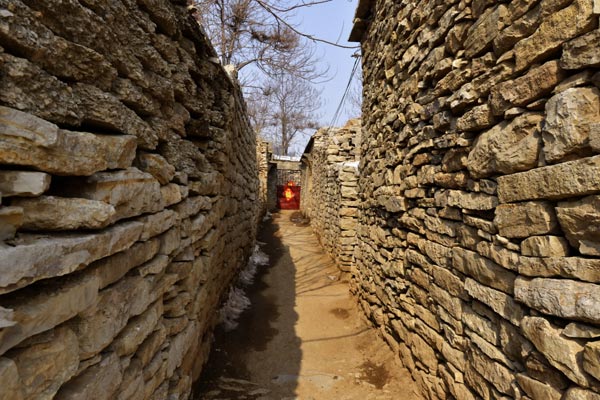
Most of the buildings in Fangyu village are made of stones.[Photo by Ju Chuanjiang/for China Daily] |
The Qi wall was built to defend the Qi State against other competing states during the Spring and Autumn Period and the Warring States Period.
"The Qi wall divided warring states in China, while the Qin wall marked (Central) China's northern frontier," Feinman says.
|
|
|
|
During the Spring and Autumn Period and the Warring States Period, China was divided into smaller areas run by different states that expanded their territory by fighting their neighbors. More than 480 wars took place during that time. The leaders of each of the states built different types of fortifications to protect themselves.
The Qi State was a powerful state in those days and was under constant attack from the states of Lu, Jin and later, Chu, which originated from the middle reaches of the Yangzte River. As a result, the kings of the Qi State built walls to protect themselves.
Records of the Qi wall are first found in Zuo Zhuan (Chronicle of Zuo), one of the earliest Chinese works of narrative history. The book, which records history from 722 to 468 BC, is used by experts as an important source for understanding the history of the Spring and Autumn Period.
The book reveals that, in the year of 555 BC, the king of Qi used the wall as a defense and defeated an allied troop of 12 states at Guangli, a village that is now Xiaoli town of Changqing district in Shandong's provincial capital Jinan.
The Qin State was exterminated by Qin Shihuang in 221 BC.
In spite of various vicissitudes of history and the ravages of weather, the Qi wall has survived well. Passes, gates, castles, beacon towers and parapets have been found among the remains of the Qi wall. "One of the things that we learned by following the path of the Qi wall was how well engineered and planned this wall was," Feinman says.
"The section of the wall that we followed was built to avoid low areas as much as possible. It follows the topography and only descends when there were no other options."
The Qi wall takes advantage of mountains. Some parts of the wall use steep mountain cliffs as a natural fence.
Copyright 1995 - . All rights reserved. The content (including but not limited to text, photo, multimedia information, etc) published in this site belongs to China Daily Information Co (CDIC). Without written authorization from CDIC, such content shall not be republished or used in any form. Note: Browsers with 1024*768 or higher resolution are suggested for this site.
License for publishing multimedia online 0108263 Registration Number: 20100000002731 












 Raymond Zhou:
 Pauline D Loh:
 Hot Pot
 Eco China
 China Dream
 China Face