|
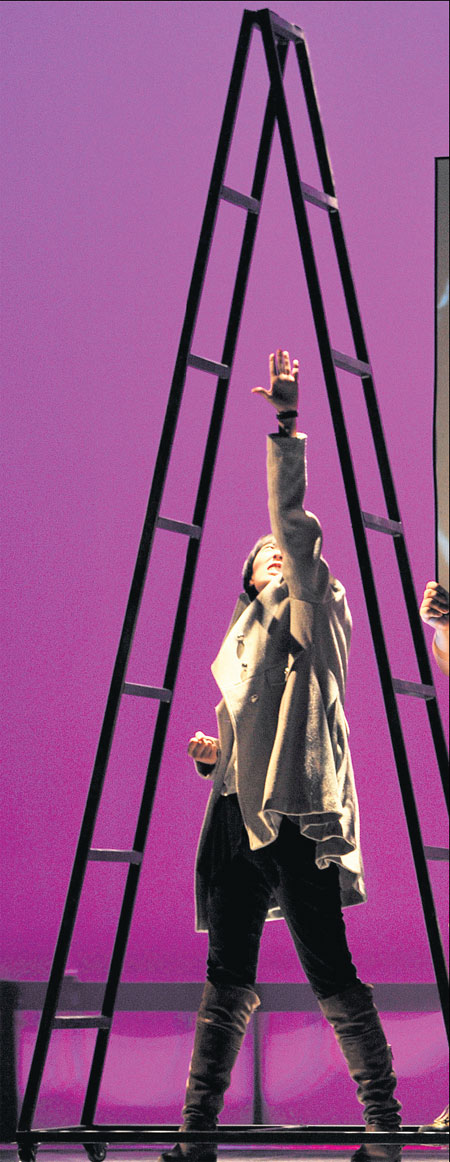
Dream Walkers, directed by Huang Ying, is one of the experimental productions staged in 9 Theater in Beijing. |
|
|
| Pinocchio sings Peking Opera |
|
|
| Chinese classic dance drama hits London stage |
Last year's citywide repertory was made up of some 200 to 300 plays, says Fu Weibo, general manager of Pioneer Theater, a venue of the National Theater of China. The Beijing Small Theater Alliance organized a monthlong exhibition program by year-end that showcased 14 plays from 12 companies, with a total of 42 performances and 13,000 patrons. Divorce, adapted from a Lao She novel, and Below the Surface of Water, a love story, emerged as the most acclaimed.
Lin Kehuan, a renowned stage director, saw 10 plays in the lineup. He praised the passion and innovation of the young people behind these works.
"When I graduated from the Central Academy of Drama in 1965, I could never imagine Chinese theater would come this far. And likewise, I cannot imagine how far it will go in another 50 years."
He sensed a theme running through most of these small productions, such as dashed dreams and aspirations and the conflict between ideals and reality-typical concerns of today's Chinese youth. "What is lacking in all the excitement is a contrast of calming down and meditation," he adds.
However, behind the rosy facade lies a big minefield and some mind-boggling paradoxes.
For example, theater venues across the country have very low occupancy rates, yet because of their State ownership they generally do not operate in accordance to free-market rules. And the capacity is growing each year with a dozen new ultramodern facilities at a cost of some 8 billion yuan, says Mao of Dao Strategy.
But a private company that produces a play has to have a healthy run to recoup the cost. "Currently the average run is 20 shows for a play, which is not enough, and most productions have to tour several cities to make the money back," Mao says.
And if you thought venue operators would bend backward to lure producers, you'd be dead wrong. Last December, a play in Trojan House, a popular venue in an office complex, was staged in frigid cold because it had failed to pay rent.
Workers in theater can barely make a living from staging plays. Cui Wenqin, a producer with Ming Theater, says they make money from staging corporate parties even though they've had a string of hit plays. Some have day jobs in the more lucrative television business.
Those who have attended festivals in Edinburgh or Avignon cannot stop oozing with envy for their Western counterparts who are given generous subsidies from their governments yet face no intervention in artistic decisions.
Copyright 1995 - . All rights reserved. The content (including but not limited to text, photo, multimedia information, etc) published in this site belongs to China Daily Information Co (CDIC). Without written authorization from CDIC, such content shall not be republished or used in any form. Note: Browsers with 1024*768 or higher resolution are suggested for this site.
License for publishing multimedia online 0108263 Registration Number: 20100000002731 















 Raymond Zhou:
 Pauline D Loh:
 Hot Pot
 Eco China
 China Dream
 China Face