 |
|
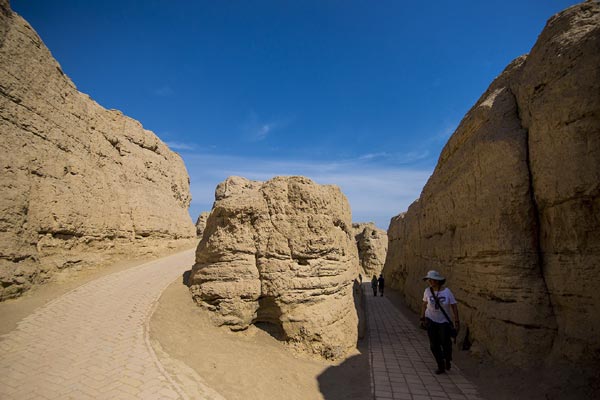
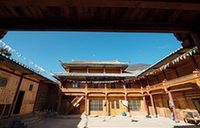
The ancient ruins of Jiaohe attract visitors in the Xinjiang Uygur autonomous region. Yu Fei / China Feature |
The ancient city of Jiaohe had archaeologists stumped. Why were the older relics found near the Earth's surface, while more recent artifacts were buried far below? Yu Fei of China Features explores the city that went underground.
Jiaohe was not built by piling bricks from the ground - up it was carved into the earth.
|
|
|
|
A bird's-eye view of the ancient ruins shows a huge aircraft-carrier shape almost surrounded by water.
Dating back 2,500 years, Jiaohe was once a key city on the ancient Silk Road trading route. Today it lies 10 kilometers west of Turpan, in Northwest China's Xinjiang Uygur autonomous region, a silent witness to the cultural, economic and political exchanges between East and West.
"The ancients of Jiaohe were very clever to utilize the natural land-form to build the city's military defense system," says archaeology professor Chen Ling of Peking University.
The ancient city sits atop a large leaf-shaped peninsula, 1,650 meters long and 300 meters wide at its widest point, in the middle of a river. The steep cliffs, more than 30 meters high on all sides, acted as natural walls.
As with many other historical sites in Xinjiang, foreign explorers at the beginning of the 20th century took masses of precious relics from the ruins which now reside in museums in Germany, Britain and Japan.
UNESCO launched a protection project for Jiaohe in the 1990s, and organized more than 100 archaeologists to conduct a mass excavation. Although the city has reemerged from sand and dust, many puzzles remain unsolved.
Archeologist Xu Dongliang says that for along time during the excavation, archaeologists were stumped by the fact that the upper layers of many ruins of Jiaohe contained cave houses dating back 2,500 years, while the bottom layers revealed relics from the 13th century. Usually, the more recent relics are found closer to the surface.
After they completed the excavation, they came to the conclusion that the city was dug deeper and deeper by generations of Jiaohe residents over 2,000 years. The city had grown downward.
Some scholars believe that the city was first built by the people of the Cheshi Kingdom, who made it their capital about 2,000 years ago.
Over generations, it developed into a political and military center in the Turpan basin, expanding with streets, lanes, residential areas, temples, pagodas, markets, government offices and graveyards.
It was finally abandoned during an invasion by the Mongols led by Genghis Khan in the 13th century.
Copyright 1995 - . All rights reserved. The content (including but not limited to text, photo, multimedia information, etc) published in this site belongs to China Daily Information Co (CDIC). Without written authorization from CDIC, such content shall not be republished or used in any form. Note: Browsers with 1024*768 or higher resolution are suggested for this site.
License for publishing multimedia online 0108263 Registration Number: 20100000002731 












 Raymond Zhou:
 Pauline D Loh:
 Hot Pot
 Eco China
 China Dream
 China Face