Finding roots
|
Researcher and author Zhang Ning says China has produced great writing about rural life but still has no proper urban fictions, because the society is still governed by its agrarian culture. Wang Jing / China Daily |
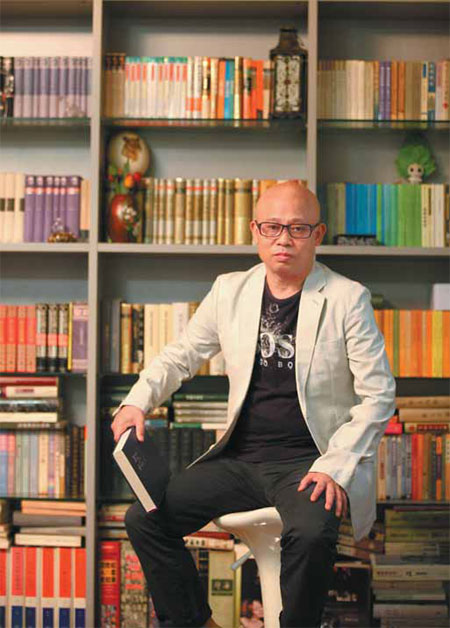
An academic says his research sheds light on the link between contemporary Chinese society and the country's agrarian past. Sun Ye reports.
Critic and researcher of Chinese contemporary literature Zhang Ning, says he has found the deep driving force behind his countrymen's mentality. He has released his findings in an updated work that documents the life of a peasant. Twilight of the Land published by the China Renmin University Press, looks at the behavior, ceremonies and lifestyles of laborers in the field.
It also expounds on Zhang's understanding of his 1.3 billion compatriots, be they urbanites or rural people.
"It's scientific research that shows we are the result of an ingrained agrarian culture," Zhang says. "It explains why city life remains cumbersome and alien to us."
At the core of the agrarian influence is an insurmountable fear of strangeness, unwavering observance to ceremonies and abidance to morality and authority in the place of law, according to Zhang.
The book is categorized in sociology and ethnography. The professor of Chinese literature with Beijing Normal University says he has plenty of primary source material to back up his findings.
Zhang says he described his home village from memory.
He was born in Zhulinlong village in northern Jiangxi province. It's a village populated by Zhangs, in the tradition that only families and those who share the same surname can live there.
"That's where trust comes from," he says.
It's a place of difficult typography, shielded from the changing outside world.
"It's a living fossil of a village, simply ideal for research," Zhang says.
Moreover, he was able to study the village at arms' length because his intellectual family did not toil the land. "So I can analyze it in a more detached way," Zhang says.
Having studied various material over many years, Zhang wrote Twilight of the Land.
At 55, he came to this conclusion: "We are all guided by the agrarian culture, wherever you are, the ideas are in our blood."
|
|
|