Switching tongues, marrying languages
 |
|
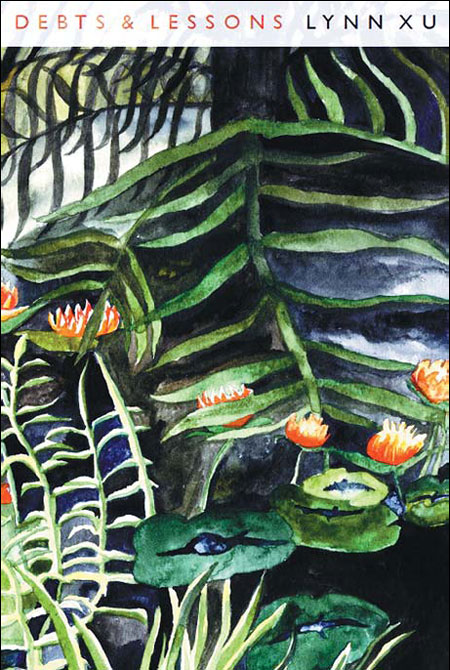
Lynn Xu's Debts & Lessons is inspired in part by Meditations. [Photo/China Daily] |
She is a rare writer who has worked well with both her mother tongue and her adopted language. Kelly Chung Dawson explores the works of Lynn Xu, in New York.
 |
|
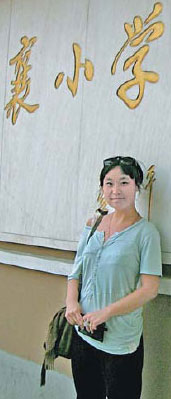
Lynn Xu visits her elementary school in Shanghai. [Photo/China Daily] |
When Lynn Xu was a child, she was diagnosed with a severe allergy to the sun. As a result, she spent long days indoors with her grandmother, pouring over classical Chinese poems. Brimming with evocative images of lonely men on snow-ringed lakes and mountains, the poems made an indelible impression. Through the playful rhythms of an art form known for its meditative images, Xu came to view language and the world in a distinctive manner that shapes her writing even today.
In Debts & Lessons, a collection of poems written in both China and the United States, Xu explores the resonance of connections between lovers, friends and cultures.
Inspired in part by Meditations of Marcus Aurelius, the work is as likely to reference the Spanish poet Federico Garcia Lorca as the Chinese writer Gu Cheng.
In honor of the latter, whose work with the "Misty Poets" movement is said to have influenced China's first generation of rock musicians, Xu writes: "Autumn 1981/ I am not born/ But my clothes are blowing in the street/ And through the trees/ Flowing up along the road."
In a poem dedicated to Emily Dickinson, she presents four Chinese characters, all pronounced "ye", strung together to mean: "Night/ Also/ Pages/ Wild."
Raised in Shanghai and the US, Xu began writing creatively in Chinese during high school. Later she won a Fulbright scholarship to write poetry in China, the results of which are included in this collection.
She is currently studying for a PhD in comparative literature at the University of California, Berkeley, through the Jacob K. Javits fellowship.
Although she has worked to retain her Chinese language skills, Xu considers English to be her dominant language.
"When I go back to China, I feel a sense of aphasia as this other language replaces the one I now feel most comfortable with," she says. "I wanted to test the two languages against each other, and the imagination of both the city and the subject.
"There are discrepancies between modes of experience when you transition from one language to another, and in presenting language to people who don't speak or understand that language."
|
|
|