A museum in Nanjing, Jiangsu province, has suspended the excavation of what is thought to be an imperial mausoleum following protests from archaeologists and the public.
The department of archaeology at the Nanjing Museum admitted it plans to build a heritage park and a museum on the site of the mausoleum, and said it will further consult experts before putting forward new protection measures.
 |
|
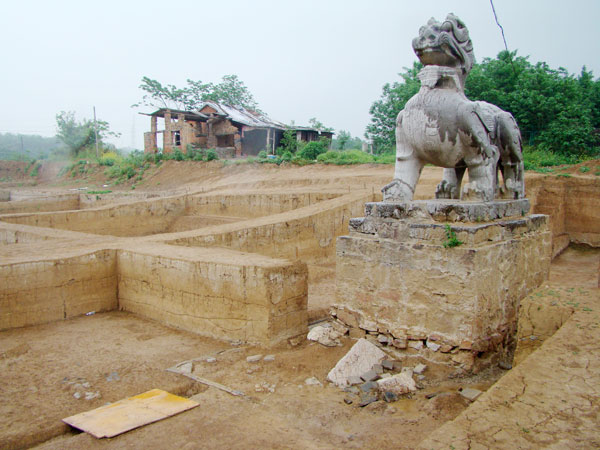
A stone Tianlu is seen outside what is thought to be the tomb of Chen Qian, the second emperor of the Chen Dynasty (AD 557-589). Tianlu is a mythical Chinese hybrid creature considered to be able to bring good luck and fortune. Provided to China Daily |
It also denied in a statement released on Saturday that any business programs were involved in the excavation.
In November, archaeologists from the Nanjing Museum discovered two 16-by-7-meter tombs in Xinhe, a village in the city's Qixia district. The tombs were later suspected to be the mausoleum of Chen Qian, the second emperor of the Chen Dynasty (AD 557-589), which is also known as the Southern Chen Dynasty.
In January and February, the Nanjing Museum and the city's cultural, radio, press and publishing bureau held two news conferences announcing the construction of a heritage park and a museum that will occupy 80,000 square meters.
In April, heritage conservation activists began to protest by reporting to the State Administration of Cultural Heritage and posting on the Internet after discovering that the two tombs had been excavated.
"Imperial mausoleums, even the suspected ones, should definitely not be excavated," said Xie Chensheng, an expert on heritage conservation. "In fact, the excavations are generally carried out to rescue relics found in construction sites. It's a rule that people shouldn't take the initiative to excavate tombs."
In the late 1950s, Beijing excavated the mausoleum of Emperor Wanli and his two queens of the Ming Dynasty (AD 1368-1644). But due to the limited technology of the conservation and recovery of unearthed relics, large amounts of the artifacts, especially textiles, were destroyed.
Soon after the excavation of Wanli's mausoleum, the State Council said that imperial tombs may not be excavated. In 1987 and 2012, the State Council again said that the safety of cultural relics is the most important and imperial tombs should remain undisturbed, according to Yao Yuan, a cultural scholar from Nanjing University.
"The establishment of any cultural program is no excuse for digging into an imperial mausoleum," Yao said.
Yao and two other Nanjing residents have submitted an application to the State Administration of Cultural Heritage, Nanjing urban planning bureau and the city's administration of cultural heritage, calling for a public hearing on the excavation.
"The archaeological department (in Nanjing) has violated the principles of protecting the integrity and maintaining the original appearance," the application read.
So far they have received no answer from the departments.
 |
 |
|
Daoqing shadow play gets protection and inheritance in Gansu |


Copyright 1995 - . All rights reserved. The content (including but not limited to text, photo, multimedia information, etc) published in this site belongs to China Daily Information Co (CDIC). Without written authorization from CDIC, such content shall not be republished or used in any form. Note: Browsers with 1024*768 or higher resolution are suggested for this site.
License for publishing multimedia online 0108263 Registration Number: 20100000002731 







 Raymond Zhou:
 Pauline D Loh: My Chinese Kitchen
 Ye Jun:
 China Face
 Hot Pot
 Eco China