Cast in bronze
 |
|
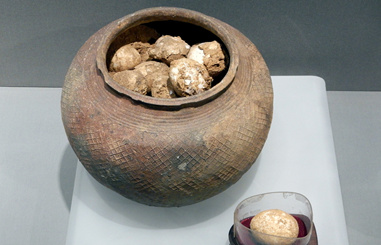
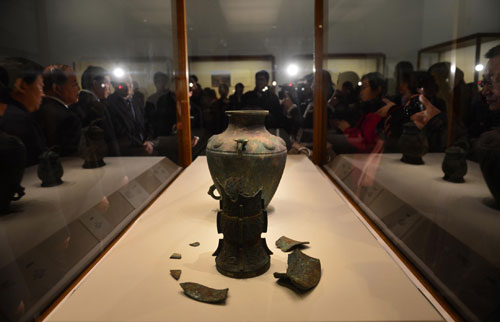
Visitors are fascinated by bronze ware displayed at the Watching and Guarding Home Exhibition, at the National Museum of China. Jiang Dong / China Daily |
One third of the items in the current exhibition were just discovered last year.
"My neighbors were building a new cabin and has dug a hole which was about 8 to 9 meters deep," recalls villager Xu Haijun from Shizuitou village, Shigu town in Baoji, who accidentally uncovered some of the treasures last June.
Related: Terracotta Warriors cry out for clean air
Xu attributes his discovery to his curiosity. "I stood by and watched for a few minutes," says the 30-year-old, who works at a pumping station. He suddenly heard a clink, and shouted at the workers to stop because he thought the water pipe had been broken. However, when the earth was cleaned, the workers found that their tools had hit bronzes. Xu immediately reported the situation to local authorities.
The find is not an everyday occurrence, he says. "I only heard about one neighbor once finding a relic at the field many years ago. Don't misunderstand we can easily find treasures because we lie on them," he says, giggling.
"But when more villagers build new houses and excavate deeper foundations, I guess more relics will be found."
Archaeologists unearthed a rare item called jin, of the Western Zhou Dynasty, in the hole. It was the first time after the founding of the People's Republic of China in 1949 that this coffee table-shaped artifact was discovered, and so it has become a highlight of the Beijing's exhibition.
According to Yang Hongbin, deputy director of Baoji municipal cultural relics bureau, only five pieces of jin were ever found, all in Baoji. Two others are also being exhibited, one in the Tianjin Museum and the other in New York's Metropolitan Museum of Art.
Jin means "to forbid" in Chinese. It is said the king promoted it to remind the aristocrats to control themselves because the previous dynasty, the Shang (c. 16th century-11th century BC) declined largely due to its last king's dissipated life, especially his excessive drinking.
|
|
|
| Stitches of reality | Stitches from time |