 |
|
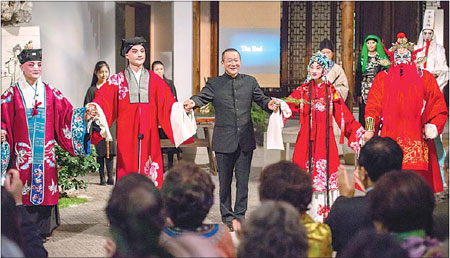
Academy Award winner and director of The Peony Pavilion Tan Dun greets the audience with cast members at the Astor Court in New York's Metropolitan Museum of Art. Stephanie Berger / for China Daily |
Met stages The Peony Pavilion in Ming Dynasty-style garden court
Related: New version of 'Peony Pavilion' makes debut in New York
The Peony Pavilion, a masterpiece of Chinese Kunqu opera from the 16th century, proved its durability by thrilling New Yorkers in a fresh production directed by Academy Award-winning composer Tan Dun.
Co-produced by the Metropolitan Museum of Art and the US-China Cultural Institute, Tan's version blends opera with lush backdrops from the eight-gallery exhibition Chinese Gardens: Pavilions, Studios, Retreats in the museum's Astor Court.
The Met opened the Astor Court in 1981, in an early example of a China-US cultural exchange. It's modeled on a courtyard in the Master of the Fishing Nets garden in Suzhou, Jiangsu province, in East China.
The original, built in the 12th century and restored in 1785, is recognized as a World Heritage Site by the United Nations Educational, Scientific and Cultural Organization.
Shirley Young, chairwoman of the US-China Cultural Institute, said the collaboration is meant to integrate visual arts with traditional Chinese performing arts in order to enhance the audience's experience.
"This is the first time that an operatic performance has taken place in the Astor Court, the first authentic Ming Dynasty-style garden court constructed outside China," she said.
Much as the Suzhou gardens took designers and craftsmen years to complete, Tan's 70-minute version of The Peony Pavilion was a long-term labor of love.
"I started to have a dream five years ago," said Tan, who won the Academy Award for Best Original Score in 2000 for Crouching Tiger, Hidden Dragon.
"A couple of years later, during the (2010) Shanghai Expo, I was having tea one day in garden surroundings," he recalled.
"All of a sudden I was inspired by the beauty of flowers, singing birds, fish, the flowing water. Then I asked myself, 'Why not stage a show that can blend the beauty of traditional Chinese gardens?'"
The opera, whose four-day run ended on Sunday, attracted prominent guests, including many involved in international cultural exchanges such as UNESCO's assistant director-general for strategic planning Hans d'Orville, China's permanent representative to the UN Ambassador Li Baodong and head of the Met's Asian art department Maxwell Hearn.
"There is a mood established by the haunting sound of the guqin, the bamboo flute - all the traditional Chinese instruments. They were extremely evocative and brought a new kind of life to our garden," Hearn said. "The opera has accomplished so many things, the way it's brought together with the works of art and the surrounding galleries."
D'Orville said: "You can see the tangible culture and intangible culture get together beautifully. You are not only coming for the beautiful Kunqu opera, but also the link to the music, the link to the real environment."
Written by Tang Xianzu during the Ming Dynasty (1368-1644), The Peony Pavilion is a story of lovers united in dreams. Since its presentation in 1598, it has come to be regarded as the most important work of Kunqu opera. Performances are often in gardens, another integral part of Chinese culture.
In 2001, UNESCO designated Kunqu opera "a masterpiece of the oral and intangible heritage of humanity".
liuyuhan11@chinadailyusa.com

Copyright 1995 - . All rights reserved. The content (including but not limited to text, photo, multimedia information, etc) published in this site belongs to China Daily Information Co (CDIC). Without written authorization from CDIC, such content shall not be republished or used in any form. Note: Browsers with 1024*768 or higher resolution are suggested for this site.
License for publishing multimedia online 0108263 Registration Number: 130349 





 Raymond Zhou:
 Pauline D Loh:
 Hot Pot
 Eco China
 China Dream
 China Face