 |
|
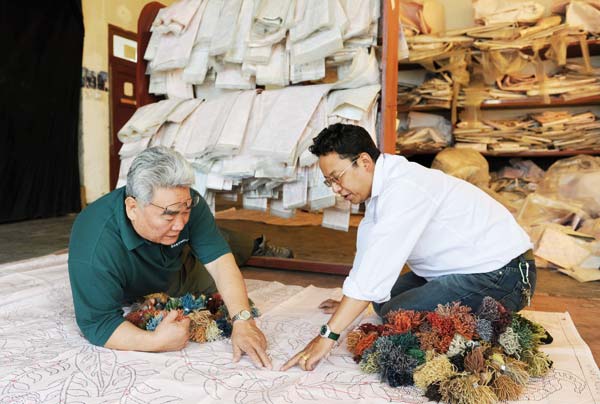
Tashi discusses with a designer the details of a new carpet. |
When Kesang Tashi talks about his Khawachen Tibetan rugs, his eyes have a certain glow.
"I want to produce the most authentic carpet in the 'Land of Snows'," says Tashi, 69, referring to the English translation for Khawachen.
Coming from a long line of visionary community leaders referred to as "jindhas" or "merchant patrons of society" in the Shangri-la region in Diqing prefecture, Yunnan province, Tashi left his homeland at age 9 to live in India and the US.
But he has always had a strong bond with Tibetan people and the land, which prompted him to set up a workshop producing traditional handmade Tibetan rugs in the 1980s.
 |
|
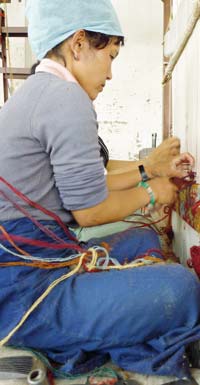
A Tibetan woman weaves a rug at the Khawachen Weaving Center. Photos provided to China Daily |
"What I have been trying to do in the Tibetan highland for the past 20 years is to chase a beautiful rainbow," he says. "Because attempting to revitalize a collection of beautiful Tibetan art and craft products and making this effort sustainable and enduring, is as illusive as chasing the rainbow."
Tashi recalls his return to Tibet in the 1980s - he saw lots of machine-made carpets of low quality on the market and wondered where all the ancient carpets were.
"As far as I can remember, handmade Tibetan carpets were part of my youth. My home was filled with beautifully handmade Tibetan rugs, some lovingly passed down through generations," Tashi says.
That absence of an important childhood tradition motivated Tashi to take action. Following the example of his father and grandfather, he dove into social entrepreneurship. He sought out master weavers and dyers in Tibet and established a workshop in Lhasa, to train a new generation of apprentices.
Within a few years, the workshop had evolved into the Khawachen Weaving Center, which remains the largest employer of rug weavers, master dyers and other artisans in the vicinity, generating a livelihood for many artisans.
The center produces about 300 rugs a year with annual sales of 2-3 million yuan ($317,500-$476,200). Tashi introduces these Khawachen treasures to high-end Chinese, European and American markets. The selling price is 30 times higher than an ordinary rug.
One of the Tibetan carpet weavers at Khawachen, Chudor, has 37 years of experience. He has been carpet weaving since he was 11 years old.
Chudor says when he was a child, villagers wove carpets at home and sold them in markets. Khawachen has provided a place for everyone to gather and work together.
"Weaving is a slow process, but fine products always come from slow work," Chudor says.
Tashi agrees, saying that's the beauty of Tibetan rugs.
"From spinning to coloring, from cleaning to weaving, one rug takes about 30 to 50 days to complete," Tashi says. "But exquisite work and fine details will make each artisan and consumer understand that the value of each carpet is reflected in the spirit of tradition."
Contact the writers through guoanfei@chinadaily.com.cn.
Liu Wenwen contributed to the story.
Copyright 1995 - . All rights reserved. The content (including but not limited to text, photo, multimedia information, etc) published in this site belongs to China Daily Information Co (CDIC). Without written authorization from CDIC, such content shall not be republished or used in any form. Note: Browsers with 1024*768 or higher resolution are suggested for this site.
License for publishing multimedia online 0108263 Registration Number: 130349 









 Raymond Zhou:
 Pauline D Loh:
 Hot Pot
 Eco China
 China Dream
 China Face