Emperor Qin Shi Huang (259-210 BC) came to the throne of the Qin kingdom at the age of 13, and took the helm of the state at the age of 22. By 221 BC, he had annexed the six rival states of Qi, Chu, Yan, Han, Zhao and Wei and established the first unified state in China's history.
Qin Shi Huang, or the First Emperor, conscripted some 700,000 convicts to build his mausoleum immediately after taking the throne so as to ensure his peaceful and eternal sleep. It took 38 years to complete the project.
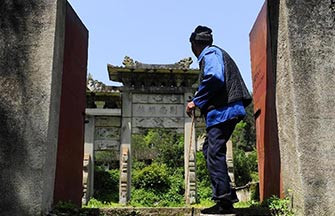
Qin Shi Huang's Mausoleum is located at Lishan Mountain in Lintong district, Xi'an, capital of Northwest China's Shaanxi province. The tomb is square with a flat roof and it measures 76 meters in height, 345 meters in length and 350 meters in width from the north to south, covering 120,750 square meters.
An archaeological survey showed that the burial site has inner and outside areas. The mausoleum is unexcavated and well-protected. Three pits with large numbers of terracotta warriors and horses were found 1 kilometer east of the mausoleum.
The No 1 pit was discovered by accident in March 1974 when farmers from a nearby village found some broken pottery figures when digging a well.
Archaeologists found the life-size pottery figures were the terracotta warriors and horses of Qin Shi Huang. The pottery figures later became known as the Terracotta Warriors.
In 1976, the No 2 pit was found 20 meters north of the No 1 pit, and the No 3 pit 25 meters north of No 1 after a drilling survey.
The terracotta warriors and horses were arrayed according to the Qin Dynasty battle formation, symbolizing the troops keeping vigil beside the mausoleum. The figures vary in face and height, even in their facial expressions.
This discovery aroused much interest in China and abroad. In 1975, a museum, housing the site of the No 1 pit and covering 16,300 sq m, was built with the permission of the State Council.
The museum officially opened to the public on Oct 1, 1979.
The total area of the three pits exceeded 20,000 sq m and more than 8,000 pottery figures as well as a number of chariots and weapons were excavated from the pits.
In 1980, two bronze chariots were found, and they were the largest ones in China.
The first excavation for the No 1 pit was carried out between 1974 and 1984 when 1,087 terracotta warriors and horses were unearthed.
Later in 1985, the museum started the second excavation, but it only lasted for a year because of limited technology and equipment.
The warriors, which were supposed to be standing, were broken when they were unearthed. After repair and restoration by archaeologists, the Terracotta Warriors were shown the way they were buried.
Based on the soldiers' density, archaeologists believe that much of the Terracotta Warriors remain buried.
The mausoleum of Qin Shi Huang and the Terracotta Warriors, which are among the world's greatest archaeological discoveries, were put on the World Heritage List of the United Nations Education, Scientific and Cultural Organization in 1987.
China Daily
Copyright 1995 - . All rights reserved. The content (including but not limited to text, photo, multimedia information, etc) published in this site belongs to China Daily Information Co (CDIC). Without written authorization from CDIC, such content shall not be republished or used in any form. Note: Browsers with 1024*768 or higher resolution are suggested for this site.
License for publishing multimedia online 0108263 Registration Number: 130349 










 Raymond Zhou:
 Pauline D Loh:
 Hot Pot
 Eco China
 China Dream
 China Face