Protection needed for booming AI businesses
|
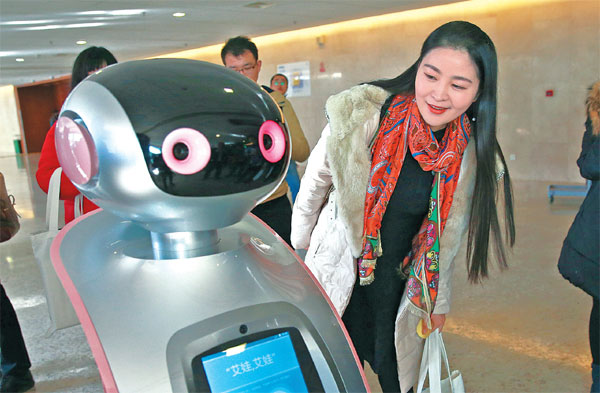
A visitor interacts with an AI robot at a high-tech event on Nov 23, 2016, in Beijing. Zou Hong / China Daily |
New technology could help China to gain and maintain an edge over foreign competitors
Google's artificial intelligence program AlphaGo, which is capable of playing the board game Go against human players, has been making waves since it became the first computer program to beat a professional human Go player without handicaps in 2015.
As of Jan 5, AlphaGo had an online record of 60 consecutive wins, and as it continues to grab headlines, intellectual property protection concerning AI technologies has also become a hot topic among industry insiders.
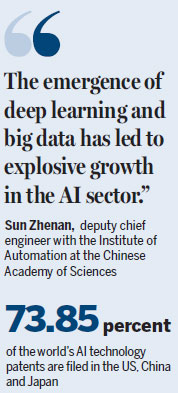
Internet-related technologies promote innovation and growth in the sector, Sun Zhenan, deputy chief engineer with the Institute of Automation at the Chinese Academy of Sciences, said at a forum on AI and its intellectual property in mid-December last year.
"In particular, the emergence of deep learning and big data has led to explosive growth in the AI sector," Sun said.
Patent filings in the sector have maintained a steady growth momentum over the past two decades, with the United States taking the top spot, followed by China and Japan, according to reports in the Chinese media.
The three countries contributed 73.85 percent to the total patents concerning AI technologies worldwide, according to a report on global AI development, which was released during the World Internet Conference in Wuzhen, Zhejiang province, last November.
With its technological edge in research into voice, text, image and facial recognition, China is well placed to compete globally when it comes to AI, Sun said.
The accurate voice recognition system developed by Baidu, China's leading search engine service provider, is a prime example. The technology, which can recognize both English and Chinese speech, was ranked among the 10 Breakthrough Technologies 2016 by the MIT Technology Review.
Wang Haifeng, vice-president of Baidu, told Chinese media that the future of any technology depends on its ability to make a user's life easier. "The simplicity and user-friendliness of any piece of technology makes it accessible to both children and the elderly, and this is where voice technology stands out."
In comparison, the US takes the lead globally in developing brain-inspired cognitive systems and computing models, neuromorphic chips and quantum computers, experts said.
Different from the US, which places greater emphasis on fundamental research, AI technologies from China focus more on commercial use.
Industry insiders have called on Chinese companies to focus more on the cutting edge of AI research and development.
An appropriate patent strategy is crucial to protect AI research, said an official at the State Intellectual Property Office, who spoke on condition of anonymity.
Many AI technologies involve interdisciplinary research and, as a result, their patent filings tend to be complicated, the official said.
Ma Xiaoya, a partner at a Beijing-based IP agency firm, said patent filings in the AI sector generally cover the collection and processing of mass data, model training, deep learning, algorithm optimization and functional modules. These are easily classifiable as non-patented intelligence activities.
Thus, patent filers need to pay attention to the required documentation for specific technological resolutions, she noted.
The choice of the location and timing for patent filings has a close proximity with the patented technologies' industrialization and commercialization.
The Wuzhen Report found that the US, China and the United Kingdom contributed 65.73 percent of the world's AI businesses.
In China, the businesses cluster into such metropolises as Beijing, Shanghai and Shenzhen, which accounted for 7.4 percent of the world's total.
The boom is being fueled by the increasing number of mergers and acquisitions that are sweeping the globe, as well as an influx of capital to the sector.
Japan's SoftBank Group spent more than $32 million in taking over chip designer ARM Holdings in the UK in July. Chinese home appliance manufacturer Midea announced in May its proposed purchase of German robot maker Kuka Robotics.
The report showed the investment in the sector in 2010-15 surpassed the total of the previous six decades in China.
zhuanti@chinadaily.com.cn
(China Daily 01/19/2017 page17)