Bayer's commitment to building a healthy community
|
From left: Ma Shicui (right) serves a patient at the People's Hospital in Yimen. A doctor in Yunnan in a training program. Photos Provided to China Daily |
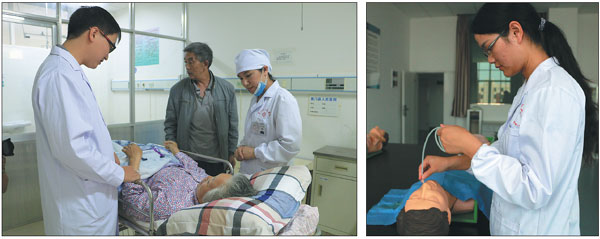
Holding the defibrillator, Ma Shicui, 40, watched the screen of the electrocardiograph machine. Without doubt, the patient was back!
Defibrillation, a common treatment for a life-threatening irregular heart rate, delivers a therapeutic dose of electric current to the heart with a device called a defibrillator.
Before the treatment, the patient's heart rate reached 249 per minute. But after the treatment by Ma, it was back to normal. Watching the rhythmic waves of the heartbeat, she was sure the patient had been saved.
"From unconsciousness to consciousness, from ventricular tachycardia to sinus rhythm, we were successful," Ma said.
This was another life-saving defibrillator treatment by Ma after she participated in a training program run by National Health and Family Planning Commission and Bayer nine years ago.
"With that training, I became confident," Ma said. "And the defibrillator is so amazing! So efective. So simple to use. Everything went so well."
In 2006, Ma began working in the emergency department at the People's Hospital in Yimen, a county in Southwest China's Yunnan province.
There was a defibrillator in the hospital, but few doctors knew how to use it. When patients came with heart problems, the doctors usually performed cardiopulmonary resuscitation. Nobody thought of using the defibrillator.
And then, Ma was given the opportunity to study in the Go West doctor training project initiated by the country's health authorities and Bayer.
During the classes and practical clinical training, Ma reviewed her knowledge of first aid and medicine administration, emergency treatment for poisoning, as well as some clinical techniques.
Combined with her experience in the emergency department and knowledge gained from other training programs, she soon grasped the techniques of using a defibrillator.
One day that knowledge was tested when a patient with ventricular tachycardia was sent to the hospital. The patient's heart rate was up to 249 per minute, his blood pressure was low and he was unconsciousness and sweating heavily.
"I felt very nervous because it was the first time we had used the defibrillator," Ma said. "So then I contacted my training teacher, followed his guidance step by step, and finally we did it."
After this, Ma became more confident when using the machine. Her colleagues in the hospital came to learn from her. And now it is common to see the defibrillator saving lives at Ma's hospital.
Ma's medical background is common in rural hospitals in western China.
As medical resources are not equally distributed between rural and urban areas, doctors in some rural hospitals need better medical facilities and training.
According to the results of research into Yunnan's healthcare system released in June, about 39 percent of Yunnan's inpatients are in rural hospitals, but the doctors and nurses in these hospitals account for only 21 percent of the total in the province, said Che Xueji, the deputy director of the healthcare administration and management office at Yunnan Health and Family Planning Commission.
"Therefore, doctors and nurses in rural hospitals are working under great pressure and their task is difficult."
But what decides the quality of healthcare service, according to Li Song, president of Kunming Medical University, is human resources; namely, the people, especially the talented people, involved. In Yunnan's healthcare system there is a shortage of doctors with the necessary knowledge and skills, Li said.
The Go West health talent training project, proposed by the National Health and Family Planning Commission and Bayer, has been operating since 2007.
Aiming to cultivate medical professionals, especially in western China, it has held 208 training sessions in China's 26 provinces, with more than 30,000 healthcare staff participating.
Among the provinces, Yunnan has the most students in the project. After eight years, more than 3,000 people in the local healthcare system have obtained more up-to-date medical knowledge through the training.
"Bayer fully supports the Chinese government in establishing a basic medical and healthcare system covering urban and rural residents," said Jiang Wei, executive vice-president of commercial operations at Bayer Pharmaceuticals China and APAC Region and managing director of Bayer Pharmaceuticals China.
"We possess the expertise and capability to help China strengthen the competence of healthcare institutions and professions and improve the service quality in underdeveloped areas," Jiang added.
"Thanks to Bayer's Go West project for building such an excellent platform for medical training," said Ma, the emergency doctor at Yimen hospital. "I also met some nice colleagues during my training, so I'm very grateful."
Li You contributed to the story.
zhuanti@chinadaily.com.cn
Bayer in China
Bayer is a leading global innovation company with core competencies in the fields of healthcare and agriculture. Its links with China date back to 1882. Bayer has been committed to China's sustainable development as a responsible corporate citizen. Over the years, Bayer has contributed to basic healthcare development by providing continued medical education to professionals in particular in less-developed areas.
The Go West project, a joint program between Bayer and the National Health and Family Planning Commission, provides continuing educational opportunities for general practitioners, equips hospitals and teaches their operators good hospital management.
(China Daily 08/31/2016 page24)