Abe floats hawkish plan
Japan's top leader makes first public statement aiming at lifting nation's military restriction
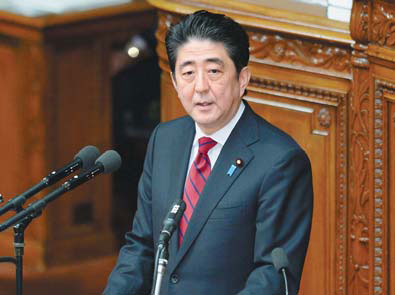
On the first day of the annual regular session of the Japanese parliament, hawkish Prime Minister Shinzo Abe publicly proposed to change the government's constitutional interpretation that now restrains Japanese armed forces from assisting allies in combat overseas.
This is his first public statement about modifying the constitutional interpretation at the parliament since he retook office in 2012, aiming to lift the country's self-imposed ban on exercising the right of collective self-defense.
Abe said Japan will "play a more proactive role for global peace and stability" with its key ally, the United States, while the existing pacifist Constitution has prohibited Japan - since its defeat in World War II - from waging war.
Engaged in a bitter diplomatic fray with his country's neighbors, Abe said his priority is to revitalize the country's sluggish economy by beating prolonged deflation.
But a military and security buildup may have become Abe's top priority because his economic stimulus package may be in trouble, observers say.
Abe's economic pledges, dubbed Abenomics, "seem more like part of a delaying tactic to seek a window and pave the way for his ultimate goal of revising the pacifist Constitution and stripping the legislative ban on military buildup," said Yang Bojiang, deputy director of the Institute of Japanese Studies of the Chinese Academy of Social Sciences.
"The frequent reference to Abenomics and his security concept of 'proactive pacifism' is meant to shore up his public image as a peaceful Abe," Yang said.
Washington continued to urge Tokyo on Friday to trying to repair relationships with China and South Korea, which have been damaged by Abe's recent visit to the notorious Yasukuni Shrine, which honors, among the dead, 14 Class-A war criminals of World War II.
After meeting with Japanese Foreign Minister Fumio Kishida and Defense Minister Itsunori Onodera in Tokyo, visiting US Deputy Secretary of State William Burns said the US urged Japan to take "constructive" action on such matters as Abe's reinterpretation of war history, Nippon Television reported.
After Abe's visit to the shrine, Washington expressed a rare statement critical of Japan, saying it was "disappointed" with Abe's decision. The US has expressed concern about the impact of the visit on Japan's relationship with its Asian neighbors, especially China and South Korea.
Liu Jiangyong, an expert on Japanese studies at Tsinghua University, said Washington now is trying to reconcile its rebalancing strategy in the Asia-Pacific and its growing relationship with China, an emerging power.
"Abe has designed a policy route that attempts to engage the US to follow Japan's strategy of deterring China, which is actually offensive to Washington," Liu said.
Chinese Foreign Minister Wang Yi on Thursday denounced Abe's justification of pledging no war when he visited the Yasukuni Shrine, describing the pledge as hollow and serving only to expose Abe's erroneous interpretation of history.
"In China, there is an old saying: The more one tries to hide, the more one is exposed," said Wang.
The Wall Street Journal on Thursday quoted several unnamed US officials as saying that they were "looking for assurances from Mr Abe that he would refrain from further comments and actions that ruffled Japan's neighbors".
"Japan created a dilemma for the US and even urged the US to choose sides between Japan and China, which has led to growing displeasure from Washington," Liu said.
Before returning to Tokyo from an economic summit in Davos, Switzerland, Abe said he saw a "similar situation" in current Japan-China relations as existed between Germany and Britain in 1914 - implying that trade and other mutual interests do not necessarily prevent war.
The Financial Times said in an editorial on Friday that Abe may have used the example in an attempt to stress the seriousness of the dispute over the Diaoyu Islands, AFP reported.
Contact the writers at zhangyunbi@chinadaily.com.cn and caihong@chinadaily.com.cn
|
Japan's Prime Minister Shinzo Abe launches the Japanese Diet's annual 150-day session with a policy speech in Tokyo on Friday. Toru Yamanaka / Agence France-Presse |
(China Daily 01/25/2014 page6)